
OG is a dedicated prediction-market website and app for sports bettors who want player markets, live trading and multi-leg Combos, with dollar funding and price-controlled orders. Crypto.com launched it on February 3, 2026; OG announced its spin-off as an independent company in September. This review covers the consumer experience at OG.com, rather than the Predict tab inside the Crypto.com app or the separate Predict Pro service.
Our recommendation: consider OG for its sports tools and funding choices, then compare the actual return before buying. A 50¢ contract is not an even-money bet after fees, and a canceled event does not necessarily refund your purchase price. The six answers below explain the costs, exits and banking first. Use Book vs Market for the available comparison prices.
What should you know before joining OG?
OG combines a regulated exchange with a consumer trading app. Here are the answers that determine whether its account, markets and payment arrangements fit your betting routine.
Is OG a legitimate, regulated platform?
Yes. Its event contracts trade on North American Derivatives Exchange, Inc. (NADEX), a CFTC-registered exchange and clearinghouse. Its broker is Foris DAX FCM LLC, branded OG.com Broker. That identifies the entities behind the trading service. For the fully funded $1 contracts discussed here, the amount at risk is your purchase cost plus fees; regulation does not protect that money from a losing outcome.
What can a sports bettor actually trade?
Game winners, spreads, totals, player outcomes and Combos, alongside non-sports events. A normal correct $1 contract returns $1; an incorrect prediction returns zero. The same app also contains other products, so this review focuses on event contracts rather than leveraged crypto trading or collectible-card packs.
What does a 50¢ sports contract really cost?
A hypothetical purchase of 100 contracts at 50¢ costs $51.75 when it fills immediately, including $1.75 in trading fees. A normal winning settlement returns $100, leaving $48.25 profit. The entry price, quantity and charge belong in one calculation; $100 is the total payout, not the profit.
Can you sell before the result?
Yes, when an executable closing price and sufficient buyers are available. Open Portfolio → Positions → Open → Close to review the proposed proceeds. A partial sale leaves the remaining contracts open. The portfolio’s displayed value is a reference point; the actual sale price, quantity filled and fees determine what you receive.
What settlement rule deserves attention first?
A canceled event can settle at a calculated price instead of refunding what you paid. OG’s detailed cancellation policy uses recent volume-weighted trading prices, with a fair-value fallback. That creates a different outcome from a sportsbook void. The settlement section below shows how it affects singles and Combos.
How do you get your money out?
For US customers outside New York, OG lists free ACH withdrawals and optional RTP withdrawals charging 1.5%. A linked-bank deposit can impose a seven-business-day withdrawal hold. RTP speeds the bank transfer after the funds become withdrawable; it does not shorten that funding hold. New York uses separate payment instructions.
Is OG worth opening an account with?
Yes for bettors who want a sports-focused event-trading account with props, Combos and flexible dollar funding. You do not need to buy cryptocurrency. Existing Crypto.com customers also have a practical advantage: OG can recognize their verified details and direct them through a linked login. That is a connection between the accounts, not a reason to evaluate OG using the Crypto.com app’s fee schedule.
For pregame singles alone, compare Novig first when the same market is available. Its published fee-free pregame singles beat a charged OG entry at an identical executable price. OG earns consideration through the complete package, not an assumption that it is the cheapest exchange. For frequent traders, order depth and the cost of entering and exiting matter more than a welcome reward.
How does OG compare with other prediction markets?
Compare the final cost at the same executable price and quantity. These hypothetical examples isolate trading fees. They are not simultaneous live quotes and exclude funding costs. Identical-looking team names still need matching periods, thresholds and settlement rules.
| Feature | Providers | Our assessment |
|---|---|---|
| Pregame sports singles |   |
Novig publishes zero trading fees for pregame straight bets through its app and website. At the same 50¢ price for 100 contracts, that is $50 compared with OG’s $51.75 immediate-fill cost. A better OG contract price could reverse the comparison. Check Novig’s markets. |
| Resting orders |  |
Kalshi normally charges no maker fee on a resting order, except in specified markets. OG charges for maker fills. For 100 OG sports contracts at 50¢, its formula produces approximately 44¢ after rounding. An order must actually rest and later fill to receive maker treatment. Compare Kalshi. |
| Lower-priced sports contracts |  |
At 10¢, 100 immediately matched OG sports contracts incur a 63¢ fee. Fanatics Markets’ published maximum fee schedule shows $1.60 at that price and quantity. Use the charge in the actual order preview for your decision. Sharing exchange infrastructure does not guarantee matching retail fees. Check Fanatics Markets. |
What is the OG app and desktop experience like?
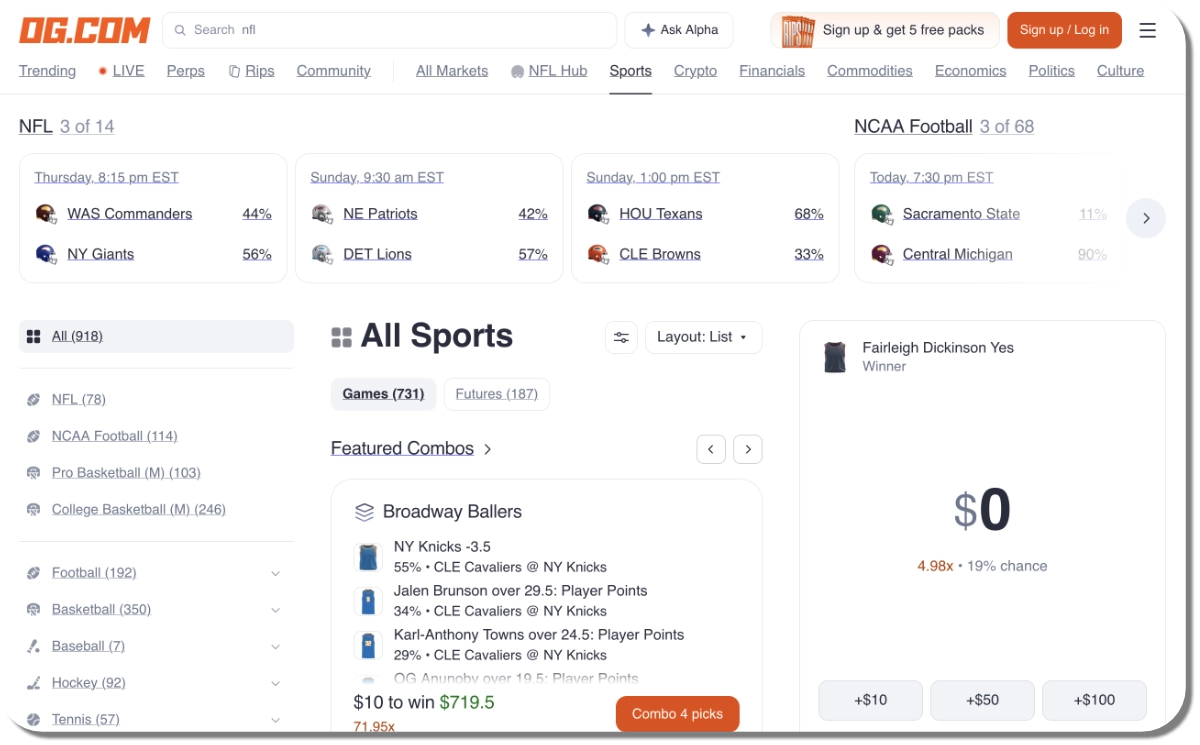
OG gives you search, event pages and a portfolio for positions, orders and cash activity. Search covers active events, players and futures. The order preview separates quantity, estimated price, fees and potential payout. OG removed American-odds display in September 2026; percentage prices and its fee-inclusive payout multiplier are the current reference points. The images below are official promotional visuals, not screenshots from our own funded-account test.
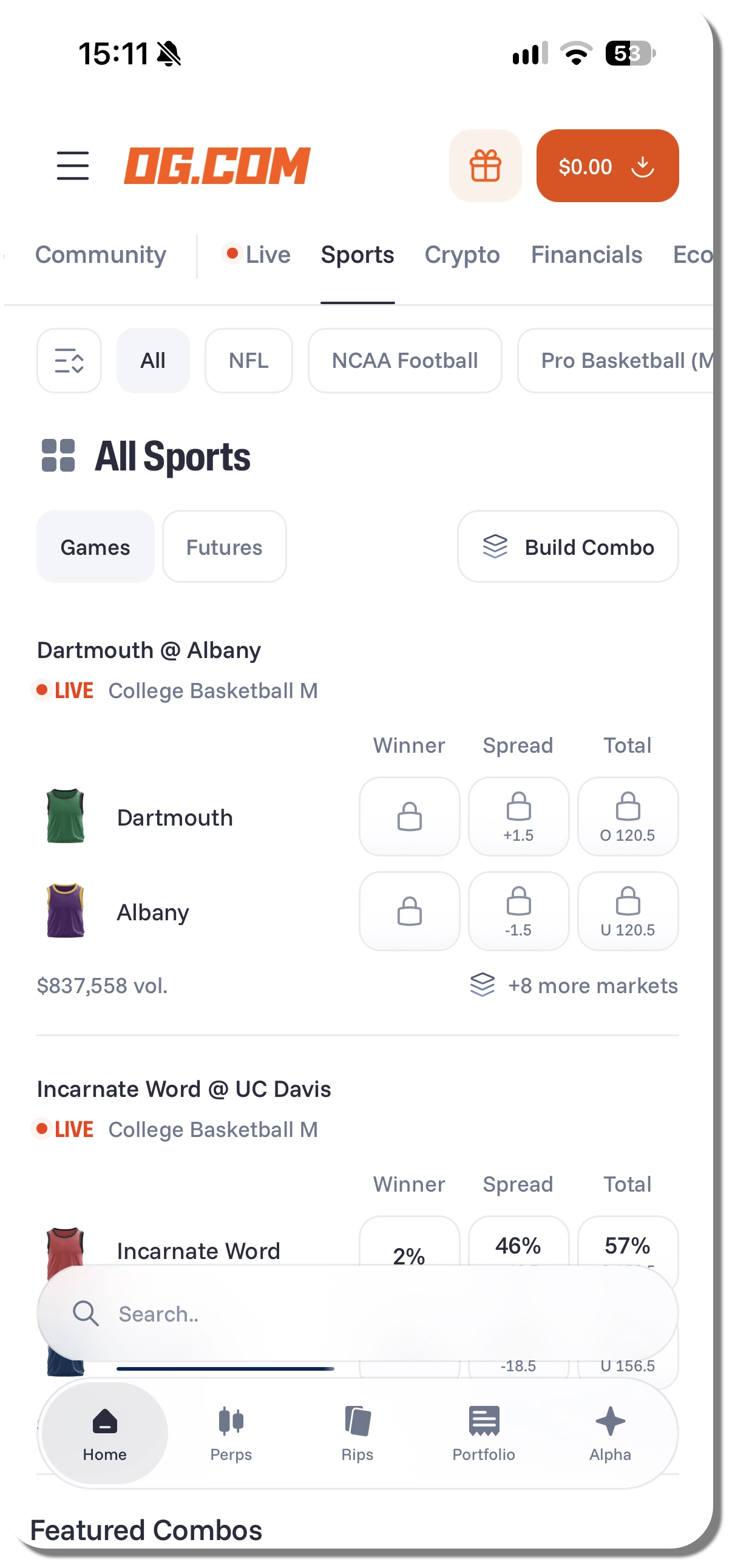
OG prompts recognized customers to use their existing Crypto.com credentials, and verified details can carry over. Its US portfolio guide, excluding New York, also documents a shared cash balance for linked accounts. Look for Crypto.com activity in the cash history when reconciling a deposit or withdrawal. Existing balances and account links make OG distinct from starting an unrelated account; they do not make the two interfaces identical.
Who can open an OG account, and what must you verify?
US applicants must meet the age-of-majority requirement, complete verification and qualify for the underlying trading services. OG’s terms distinguish the consumer account from exchange and broker approval. Its February launch and September spin-off describe the brand’s history; NADEX supplies the older regulated exchange infrastructure behind it.
How should you check state access?
Check sports-contract access for your location, not just whether OG’s homepage opens. The official material reviewed does not provide a single reconciled nationwide sports list. Its support center also has separate New York funding pages. Our state guide supplies the broader comparison; the enabled markets in your verified account establish the specific product you can use. This review does not claim sports access in all 50 states.
What information does registration require?
Email and phone verification, legal name, date of birth and Social Security details. OG’s signup guide describes six-digit confirmation codes, the last four SSN digits, and government ID or a selfie when additional checks are needed. Customers whose details match an existing Crypto.com account are directed to the linked login. Keep the name consistent with the bank account you intend to use.
What do OG customers actually report?
The useful firsthand reports concern promotional-credit presentation and a delayed withdrawal. These accounts describe OG specifically. They are not evidence about the wider Crypto.com token-trading service, nor do they establish a typical payout time or a platform-wide failure rate.
We have not independently audited these customers’ transactions or tested a funded OG withdrawal. The published terms explain the reward issue; the payment complaint remains an allegation without a confirmed resolution in the material reviewed.
Why did a customer lose part of a $25 reward?
An October 30 App Store reviewer said they used only $5 of a $25 coupon and lost the remaining $20. They had expected the coupon to be added on top of the amount entered. OG’s developer response directed the customer to support. Its published reward rules explain the mechanism: an undersized order forfeits the unused coupon balance. The practical check is the amount actually covered in the order preview.
What does the withdrawal complaint establish?
A Reddit user reported that a $2,075.18 withdrawal requested July 24 had not reached their bank seven weeks later, despite appearing processed. They also said they had escalated the issue. We did not verify the bank records, an adjudicated finding or a final outcome. The case supports asking for a transfer reference and a written status explanation; it does not establish that OG routinely fails to pay.
How do orders behave when prices move?
Quick orders prioritize execution; limit orders control your price. The distinction matters when you are entering a busy live market or trying to exit a position larger than the quantity available at the displayed quote.
What happens to the unfilled part of an order?
A Quick order cancels its unfilled remainder; a limit order leaves that remainder working. Quick ($) targets a spending amount; Quick (#) targets a contract quantity. Suppose a 100-contract limit fills 40: you own 40, with 60 still pending. Canceling the remainder in Portfolio → Orders stops only those 60. Selling the 40 is a separate trade. Limit orders are not available for Combos.
What should live bettors allow for?
OG normally delays live sports orders by three seconds before submission to the order book. Its exchange can specify a different delay. Quick orders also have price-dependent slippage protection: at a 50¢ live price, the published tolerance is up to 5¢ per contract. Across 100 contracts, that is up to $5 of price movement before fees. A limit provides price control, but not a guaranteed fill.
Markets, settlement and the real cost
Which OG markets and features are useful for sports bettors?
The core offering covers mainstream sports, player selections and event trading beyond sports. What makes the account useful is finding the exact proposition, combining compatible selections and managing the resulting position—not the number of categories in the menu.
Does OG cover more than game winners?
Yes: spreads, totals, player markets and futures sit alongside winners. Its menu covers football, basketball, baseball, hockey, soccer, tennis, golf and combat sports. Within an event, open More markets for additional selections. Match the full question to your prediction: a team winning in regulation and advancing after extra time are different contracts.
How many selections can a Combo include?
Between two and 20 eligible sports legs. OG supports pregame picks, selected live games and same-game combinations in selected leagues. Championship futures and non-sports events are excluded from this builder. Early closure requires an available quote. A larger maximum helps accommodate combinations; it does not improve the probability that all the selections win.
What is available beyond sports?
Political, economic, financial and cultural outcomes. The public catalog includes elections, Federal Reserve decisions and entertainment events, as well as timed asset-price markets. For a financial threshold, the specified observation time and reference source matter as much as the direction you predict. These categories also have different fee treatment from sports.
What do Alpha and the social feed add?
Alpha helps research events; the social feed lets you follow traders and revisit their selections. A copied idea receives the price available when you act, not the original entry. For more privacy, Settings → Profile → Profile visibility → Minimum hides trading statistics and recent trades and removes leaderboard eligibility. Alpha’s output remains something to evaluate, not a verified winning forecast.
Which settlement rules can change the money you receive?
Cancellations, ties and player nonparticipation do not necessarily work like sportsbook refunds. The detailed settlement policy and the specific contract resolve these cases. These are the rules worth reading before selecting a player prop or building a Combo.
Does a cancellation return your original stake?
Not necessarily. OG uses a one-week volume-weighted price, with a fair-value fallback, and refunds opening trading fees. Hypothetically, 100 Yes contracts bought at 65¢ and settled at 40¢ return $40 against $65 spent on the contracts. The refunded fee does not restore the $25 difference.
What happens to a canceled Combo leg?
Its settlement value stays in the calculation rather than simply disappearing. OG multiplies the legs’ settlement values. If three illustrative values are 0.40, 1 and 1, each Combo contract returns 40¢. A leg settling at zero makes the Combo lose; otherwise the remaining legs still have to resolve.
What if an NFL or NBA player never enters?
OG’s player rules distinguish an active nonparticipant from a player declared inactive before the game. Its football and basketball guidance treats active players who never participate as out-of-the-money, while pregame inactive declarations receive cancellation treatment. That is a consequential difference for a player prop; check the named contract before assuming a DNP produces a refund.
Is a tied market a refunded push?
Under the general no-draw-option rule, both sides receive 50¢ per contract and opening fees remain charged. A 100-contract holding bought at 60¢ therefore receives $50 against $60 of contract cost. OG also specifies 50¢ settlement for a tied baseball first-five moneyline. The contract’s particular tie provisions govern.
OG’s help pages contain a cancellation inconsistency. Its Portfolio overview describes a refund, while the detailed General Settlement policy specifies price-based settlement and opening-fee refunds. This review follows the detailed policy; retain your contract specification with the order. Our markets vs sportsbooks guide explains why settlement terms belong in a price comparison.
What do buying and selling cost after OG’s fees?
For US sports contracts, the taker fee is 0.07 × C × P × (1 − P); the maker rate is 0.0175. C is the contract quantity and P is the dollar price. The charge applies when opening and when selling before settlement. OG waives the normal settlement fee. Calculations below assume a single fill at the stated price; fees round up to the cent.
Buying 100 contracts at 50¢ and selling them at 60¢ produces $6.57 net profit—not $10. Entry costs $51.75. The sale earns $60 gross less $1.68 in fees, leaving $58.32. Subtract the original $51.75. This is a hypothetical round trip, not a live quote. Holding those same contracts to a normal winning settlement instead returns $100 and leaves $48.25 profit.
Does selecting a limit order guarantee the maker rate?
No. An immediately matched limit pays the taker rate. A resting order that fills later receives maker treatment. In the same 100-contract, 50¢ example, a maker entry costs approximately $50.44 after rounding. The lower charge comes with waiting for a fill rather than a guaranteed immediate purchase.
Which contracts use a flat fee instead?
Crypto, foreign-exchange, commodity and equity-index contracts cost 2¢ per contract per trade. A 100-contract opening costs $2 in trading fees; selling all 100 adds another $2. Apply the schedule for the contract category, rather than transferring the sports formula to every market in the app.
Compare your OG return with Book vs Market
Find your event and exact selection, then compare the providers and prices returned by Book vs Market. For OG, use the live order preview alongside the tool, including fees and available quantity. If OG is not listed for that market, compare its quote manually; the tool is not a promise of complete exchange coverage.
Funding, withdrawals and account help
What is OG’s current prediction-trading welcome offer?
The published offer is a $25 bonus or rebate, followed one week later by a 100% profit boost capped at $25. Eligible new customers must complete at least $25 in qualifying trades, including fees. This is an event-trading offer—not the Crypto.com cryptocurrency-volume promotion. The version shown in your OG Promos area governs availability.
The first reward offsets an eligible trade; the later boost adds profit only on a winner. Their combined maximum value is not a $50 cash deposit. The reward mechanics below explain how much of each you can use.
Which trades qualify for the welcome reward?
Contracts must be bought below 80¢ and settle within seven days of identity verification. Reward-funded trades are excluded, and an early partial or full close disqualifies the trade from the task. A distant future therefore misses the deadline even if you buy it immediately.
When do the rewards arrive and expire?
The $25 reward follows task completion; the capped boost arrives one week later. Each expires on its seventh day at 11:59 p.m. Eastern. Welcome and referral/new-user offers cannot be combined on the same account. Choose the registration route before entering a referral code.
What changes the usable value of an OG reward?
Can you save the unused part of a bonus?
No. A coupon is used as a whole, with excess value forfeited. Apply a $25 coupon to an order totaling $10 including fees and $15 goes unused. A partial fill can also consume the coupon without using its full value. Review the coverage before confirming, without adding unwanted cash exposure solely to spend the reward.
What does the 100% boost actually add?
It doubles eligible profit only up to the $25 additional-profit cap. If the qualifying winning trade produces $12 profit, the boost adds $12. If it produces $40, the boost adds $25, for $65 total profit. Your own original trading cost is separate from those profit figures.
How does the New York rebate differ?
The rebate requires paying the full cost first and holding until settlement. Other eligible jurisdictions use an upfront bonus. OG’s reward guide excludes contracts at 80¢ or more from bonus/rebate use; boosts have no corresponding probability cap. An early full close forfeits a rebate. These are reward mechanics, not a statement that every contract is available in New York.
What does Refer a Friend pay?
The published prediction-trading referral rewards each participant with $10 in bonus or rebate credit. The friend must register through the link or code and complete $10 of eligible trades settling within 30 days of verification. Trades at 80¢ or higher, reward-funded trades and early-closed qualifying positions do not count. The reward expires seven days after issuance.
How do OG deposits and withdrawals work?
You can fund OG directly with US dollars; cryptocurrency is optional. The payment figures below follow OG’s US-outside-New-York help pages. Crypto-to-cash funding through Mesh is another route: supported assets are converted to dollars, with external network or exchange charges possible. New York customers have separate instructions and should use the methods shown in their OG wallet.
What does a bank-initiated ACH deposit cost?
OG lists no deposit fee and a $1 minimum for ACH bank transfers. Use the account and routing details under Deposit → ACH Bank Transfer from a bank account in your own name. This is the bank-initiated transfer route; the linked-bank method in the fourth card has its own withdrawal hold.
Do debit cards, Apple Pay and Google Pay cost extra?
OG currently lists no platform funding fee for these methods, with a $10 minimum. Use an eligible US-issued Visa or Mastercard debit card; a credit card behind a mobile wallet is not accepted under this guide. Your card issuer can impose a separate charge. These are OG terms, not the Crypto.com app’s top-up prices.
Can you fund through PayPal or Venmo?
Yes. OG’s dedicated PayPal and Venmo deposit options each have a $10 minimum and no listed OG deposit fee. Use their named wallet options in the deposit flow. The withdrawal guides below document payments to a linked bank, so plan the return route as well as the incoming payment.
What is the linked-bank deposit hold?
OG’s Plaid-linked deposit route has a $10 minimum, no OG deposit fee and a seven-business-day withdrawal restriction. Trading access can arrive before that money is eligible to leave. Weekends and banking holidays do not shorten the hold. For someone funding before a game and planning to cash out afterward, this is the banking condition to weigh first.
Standard ACH or faster bank delivery?
What does a standard ACH withdrawal require?
A same-name bank account linked through Plaid, at least $1 and settled, withdrawable cash. Open Portfolio → Withdraw → ACH bank transfer. OG lists no withdrawal fee; its published daily ceiling is $100,000 or five transfers. The guide does not provide a fixed bank-delivery promise. A balance awaiting deposit settlement is not yet withdrawable.
What does the faster RTP option cost?
1.5% of the transfer amount, with a $1 minimum withdrawal and a compatible receiving bank. A $1,000 withdrawal therefore costs $15. OG describes arrival typically within minutes over an around-the-clock network. Account review and funding holds precede that transfer. Once an RTP withdrawal is confirmed, the published instructions do not allow cancellation.
How do you get help with an OG account or transaction?
Use OG’s own help center and live-chat channel, including chat.og.com. Give support the OG account and transaction reference, even when your login is linked to Crypto.com. The available support channel is documented; we have not measured its response time or independently verified a routine payout turnaround.
What helps support trace a trade or withdrawal?
The order ID, filled quantity, price and fees—or the cash-transfer reference and request date. Use Portfolio → History to retrieve the record. For settlement, add the precise market question and result source. For a transfer marked processed but absent at your bank, request the payment trace/reference and ask whether the sending bank has released it.
When should you follow up on verification?
OG’s signup guide directs you to chat after three days without a verification-status change. Identify whether the delay concerns identity approval, wallet setup or a bank connection. That gives support a specific account step to investigate. Upload requested identification through the designated verification flow.
Which security controls are useful?
OG supports authenticator-based two-factor authentication under Settings → Security. Once enabled, its guide requires the code for withdrawals. Linked accounts also have a One-Button Lock: locking the linked Crypto.com account restricts OG access and trading. OG says existing positions still settle automatically and pending withdrawal requests continue processing.
What should you save before closing the account?
Withdraw available funds and save your transaction history first. OG describes account closure as permanent and says the closed account’s history will no longer be accessible. Contact OG support for the closure process. A temporary security lock and permanent account closure serve different purposes, especially when accounts are linked.
Which alternatives should you compare with OG?
Novig is the direct fee comparison for pregame singles; Kalshi is the dedicated event-market comparison for selection and resting orders. Check the identical market in Book vs Market where supported, then compare the actual quote and full order cost. None of these recommendations assumes the same liquidity or outcome wording across platforms.
Novig
Start here when your regular activity is pregame sports singles. Novig’s no-fee treatment for those app/web trades makes the purchase price easy to compare against OG’s fee-inclusive total. In-play trades, futures and other products have separate rules. Use the review to check the markets and account conditions you would actually use.
Kalshi
Compare Kalshi when event selection and placing patient limit orders matter. Its ordinary maker-fee policy differs from OG’s, subject to market exceptions. Compare the buyers and sellers available for your quantity, not just the headline quote. A cheap resting order is useful only if it fills within the period you intended to trade.
Should you open an OG account?
OG deserves consideration as a dedicated sports-and-event trading platform, not merely an extra tab for cryptocurrency customers. Search, player markets, Combo construction and ordinary dollar funding make it relevant to sports bettors. Its strongest fit is someone who will use those tools and compare complete returns. Frequent pregame-singles bettors should weigh its trading charge against Novig; customers who withdraw frequently should pay particular attention to the linked-bank hold.
Check the selection, quantity, total entry cost and settlement rule together. For an early exit, compare the actual closing proceeds; for a withdrawal, compare the amount available to transfer. Those figures tell you more about the account’s usefulness than a headline bonus or a percentage beside a team.
Explore OG’s current markets
Find your event and review the fee-inclusive order before buying.
OG Prediction Markets FAQs
Six answers covering account access, pricing and the difference between a prediction position and the other products inside OG.
Do you need cryptocurrency or CRO to use OG?
No. OG supports direct dollar funding. You can use an enabled bank or payment-service method without first buying a token. Mesh crypto-to-cash funding is optional. This review’s payment figures cover US accounts outside New York.
Can an existing Crypto.com customer use the same login?
Yes, when OG identifies and links the existing account. Follow the linked-login prompt instead of creating conflicting credentials. The US-outside-New-York portfolio guide also describes a shared cash balance, so activity in either linked service can affect available funds.
Does OG still display American odds?
No. OG says it removed that format in September 2026. Its percentage display corresponds to the contract’s cents price. The payout multiplier incorporates fees and expresses total return, not net profit. Subtract your complete entry cost to find the profit on a win.
Can you cancel an accepted prediction?
You can cancel an unfilled order; a filled holding requires a closing trade. Check Portfolio for the quantity already purchased. Canceling the remainder of a partially filled order leaves that purchased position open.
Does a quick sale release a pending deposit?
No. Selling a position and clearing its original bank funding are separate steps. Use the withdrawable balance when planning a transfer. A position can be closed while money remains subject to the linked-bank deposit hold.
Are Rips card packs the same as prediction contracts?
No. OG’s terms expressly separate Rips from its CFTC-regulated event-contract service. Rips concerns collectible cards. Leveraged crypto positions are another different product. The $1 payout examples and entry-cost risk limits in this review describe the fully funded prediction contracts, not every product in the app.