
Polymarket US earns a place on the shortlist for sports, election markets and control over the price you pay. US reviewers praise its live-odds interface. The reservations are practical: missing combo sell quotes, withdrawal delays and difficulty getting account problems resolved.
Start with Book vs Market to compare available prices for your exact pick and stake. This review covers the regulated US exchange and its app, with current fees, payment rules and customer reports. The international Polymarket platform has a separate account system and different terms.
What should you know before joining Polymarket US?
These six answers cover the account, the trading product and access to your money. The assessment combines published US rules with reports from US customers.
Is Polymarket US a legitimate operator?
Yes. QCX runs a CFTC-designated exchange, and QC Clearing is a registered clearinghouse. Positions are fully collateralized. Customer funds held within that clearing framework are not insured bank deposits. Regulatory registration is verifiable; service quality still needs a separate assessment.
Does it have the markets you want?
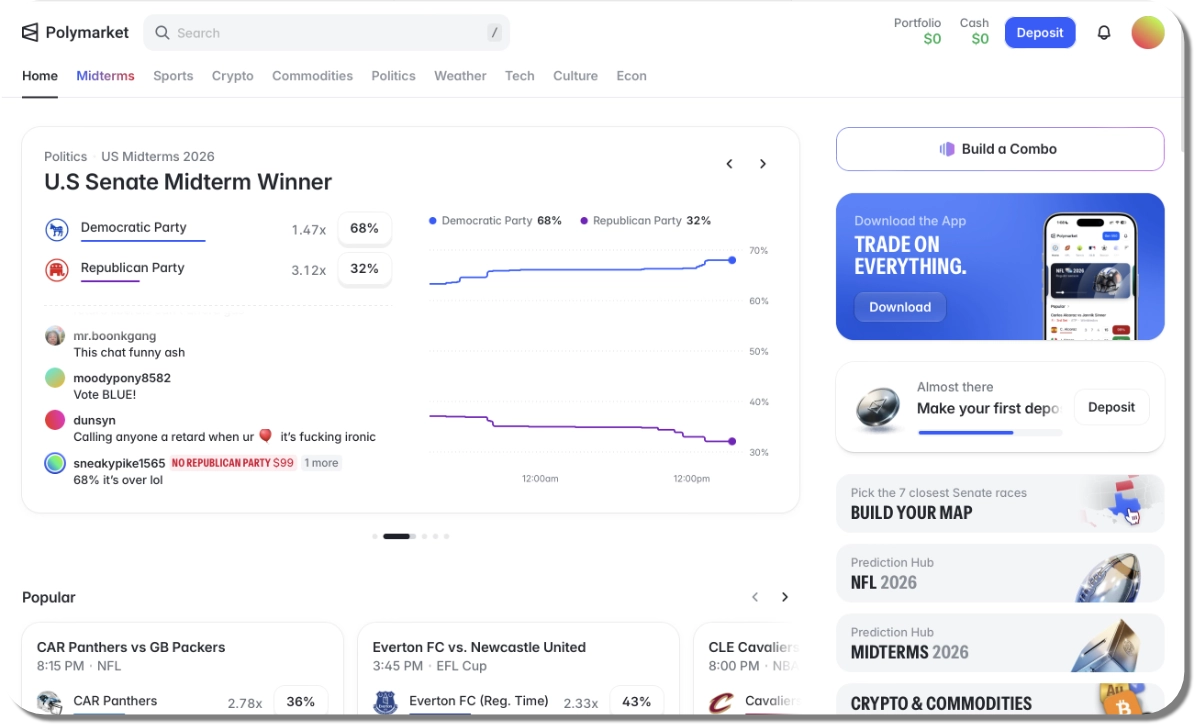
Sports singles, player props, combos, elections, crypto-price events and weather are available. The current US catalogue includes NFL and NBA selections and a dedicated midterms hub. Find your selection on the US platform; a listing on the international site does not establish US availability.
What does a trade actually cost?
Buying 100 standard contracts at 50¢ as a taker costs $51.74, including a $1.74 fee. A $100 winning settlement leaves $48.26 profit. A taker sale is also subject to a trading fee. Combos and table tennis use different rates.
Can you get out before the result?
Yes, when a buyer or executable combo quote is available. A cash-out attempt can sell only part of the position. US customers report unavailable combo quotes even when Portfolio shows a positive value. That displayed value does not guarantee a sale.
Who decides the result and pays you?
The US exchange determines the outcome under the contract’s rules; Polymarket Clearing credits settlement. Ordinary winners pay $1 per contract. Ties, cancellations and nonparticipating players can receive different treatment, including a fair-value payout rather than a stake refund.
How do withdrawals work?
Card and ACH payouts are listed at 3–4 business days, after funds become withdrawable. New deposits usually need their own 3–4-business-day clearance first. Withdrawals return to the original funding method, in deposit order. Customer reports include delays beyond routine processing.
Is Polymarket US worth opening an account with?
Yes, as an additional account for event choice and price comparison. Limit orders and the growing US catalogue give it a clear purpose. Our reservation is dependence on a timely exit or support response: the customer evidence gives concrete reasons to avoid making either essential to your plan. For pregame sports singles, its value comes from the final return after fees.
Where does Polymarket US differ from its alternatives?
The useful comparisons are the cost of your order and what happens if a leg cannot settle normally. A provider can win one comparison and lose another. These differences explain where each belongs on your shortlist.
| Feature | Providers | Our assessment |
|---|---|---|
| Pregame sports singles |   |
NoVig charges no trading fee on pregame individual-game singles. At the same price, it beats a Polymarket taker purchase on cost. A Polymarket maker fill is also free, and a better quote can outweigh the fee. Check NoVig’s prices. |
| Resting-order fees |  |
Polymarket charges no maker trading fee. Kalshi charges maker fees in designated markets. That favors Polymarket for a genuinely resting order that later fills, provided the contract terms match. An immediately matched limit order can still be a taker trade. |
| Voided parlay legs |  |
Polymarket keeps an unresolvable combo leg in the payout calculation at an assessed fair value. FanDuel Sportsbook removes a voided leg and recalculates the remaining selections under its parlay rules. Compare FanDuel Sportsbook if you prefer that treatment. |
What is the app like to use?
The US product is available on iPhone, Android and the web. One iPhone reviewer specifically praises live odds and visible gains and losses; an Android reviewer likes the app while reporting trading interruptions. The interface makes positions easy to follow for those reviewers, but execution and uptime remain separate questions.
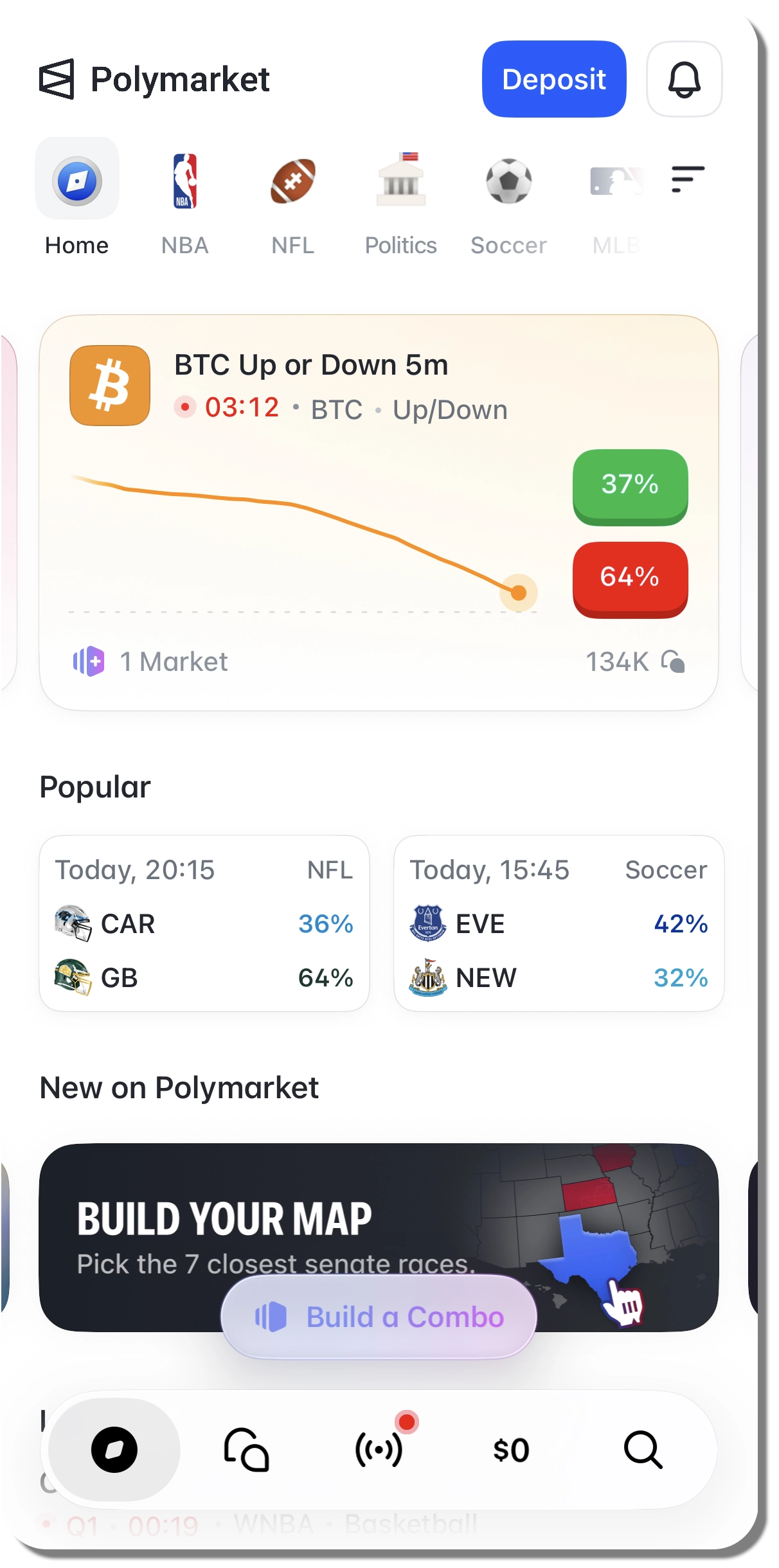
Open positions, money reserved for orders, uncleared deposits and promotional credit have different uses. Sale and settlement proceeds return to cash, but deposit-related restrictions can still apply. The available withdrawal amount is the relevant figure when you want to move money back to your bank.
Who operates Polymarket US, and who can register?
QCX LLC operates the exchange as Polymarket US; QC Clearing LLC clears its trades. Their CFTC registration dates are July 9, 2025 and December 16, 2024 respectively. Individual participants must be at least 18 and have reached the age of majority where they live.
Where is US trading available?
Polymarket’s current published US access notice excludes Nevada. That is its operating footprint, rather than a guarantee against future state restrictions. Account approval and market eligibility still apply. Our availability guide and state guide cover access in more detail.
What information does signup require?
Google or Apple login, legal name, birth date, residential address, phone verification and Social Security number. Complete verification before depositing or trading. Additional checks can require a government ID and selfie. Most approvals are automatic; the current instructions give no fixed deadline for manual review.
What do customers like, and where do they report problems?
Clear live-price displays are a specific positive; getting a problem resolved is the recurring reservation. The US app reviews and forum accounts examined include missing sell quotes, withdrawal delays and verification problems. These reports describe individual experiences, not measured failure rates.
The follow-ups change the picture. An iPhone reviewer updated a crash complaint after receiving refunds for affected positions. Users in the September outage thread also confirmed refunds, while others were still waiting for credits or disputing amounts. Separately, September BBB complaints about an account lock and a failed sale still reported no substantive response in October follow-ups.
Who gets the most useful account?
Someone who will use the event range and set prices instead of relying only on instant purchases. Following a game, a Senate race and a weather outcome within the same US account gives the catalogue a purpose beyond another sportsbook-style bet slip.
Who should compare another provider first?
Someone whose strategy requires selling a combo quickly, or whose priority is rapid withdrawal support. One US Reddit customer reported a position displayed near $100 but tiny or unavailable exit quotes. That supports scrutinizing executable offers; it does not establish why that particular quote failed.
Can you control your entry and exit prices?
Yes. Both the app and website offer market and limit orders. Market orders trade within a price limit based on the quoted price. A cash-out attempt sells the available quantity within that limit and cancels the remainder. Check the completed quantity before treating a position as closed.
Can you leave a price target working?
A limit order sets your price or better. Any unfilled amount can remain open until canceled or expired. Choices include good until canceled, game start, midnight Pacific and immediate or cancel. These controls help keep a pregame order from unintentionally remaining active during live play.
Can you trade a precise dollar amount?
Most markets support increments of 0.01 contracts. The entered dollar budget covers the trading fee as well as the purchase. The system rounds the quantity down to an allowed increment and leaves unused cash in your balance. Some futures still require whole contracts.
Markets, settlement and the real cost
Which markets make Polymarket US worth having?
The US catalogue now reaches well beyond game winners. Sports props and combos sit alongside election outcomes, financial-price events and weather. These are current US listings; the depth of a particular league or event still varies.
Sports: singles, props and live markets
NFL, NBA, MLB, NHL, college football, tennis, soccer and esports appear in the US offering. NFL pages include alternative spreads, totals and period selections. NBA additions include points, rebounds, assists, three-pointers and combined player statistics. Live trading is available, subject to each market’s trading status.
Elections: more than one national winner
The midterms hub includes House and Senate control, individual races, seat counts and election combinations. Build Your Map adds combinations of Senate-race outcomes. This is a meaningful reason to open the account if your interests extend beyond sports.
Crypto prices: short windows and thresholds
Current listings include Bitcoin, Ether, Solana and XRP price outcomes. Choices include Up/Down windows, Above/Below thresholds and price ranges. You are buying an event contract about the price; using these markets does not require buying the underlying cryptocurrency.
Weather: the measurement station matters
Temperature and precipitation markets are listed. The temperature rules use official National Weather Service climate reports. New York’s station is Central Park; Chicago’s is Midway. Those locations determine the result, so a reading from another airport or your weather app can differ.
What happens to ties, scratches and canceled combo legs?
The contract decides whether a position pays $1, $0 or an intermediate value. Polymarket’s last fair market price treatment is especially relevant to sports bettors accustomed to voids. Here is what it changes.
What happens if an NFL game ends tied?
A winner market without a separate tie outcome settles at 50¢ when no winner is declared. Paying 65¢ for a contract that then settles at 50¢ leaves a 15¢ loss per contract before fees.
Does a shortened MLB total automatically void?
No. When MLB declares an official result, the official score settles winners, spreads and totals. The published rule makes official game status decisive even when the scheduled innings were not completed.
What if an MLB player never participates?
The prop settles at last fair market price. That value is assessed at the relevant announcement and is not necessarily your entry price or the latest recorded trade. It can return more or less than you paid.
Is an unresolvable combo leg removed?
No. Its assessed value remains a multiplier in the payout. For example, 100 combo contracts with two winning legs and a third settled at 0.60 pay $60. Any other losing leg makes the whole payout zero. The Settlement Committee determines the affected leg’s fair value.
The postponement window belongs to the individual contract. The October 29 Panthers–Packers market specifies a two-day rescheduling window; beyond that, it settles at last fair market price. Other markets can use different deadlines.
What are the fees after buying and selling?
The standard taker fee is 0.0695 × contracts × price × (1 − price). Express price in dollars. Maker fills have no trading fee. The examples below assume one complete fill at each stated price, nearest-cent rounding and no rebate or funding cost.
Buy 100 standard contracts at 50¢: $50 plus $1.74, or $51.74 total. Sell all 100 at 60¢ as a taker: the $60 proceeds lose $1.67 to the exit fee, leaving $58.33. Your completed trade earns $6.59 after both trading fees. The difference between the purchase and sale prices alone would have suggested $10.
The buy/sell spread also affects the return. A hypothetical 50¢ purchase sold immediately at a 48¢ quote loses $2 per 100 contracts before fees, even with no change in the event itself.
Which single-market exception matters?
Table tennis uses a higher coefficient of 0.10. Buying 100 contracts at 50¢ therefore costs $52.50, including a $2.50 fee. An immediately executed limit order can be a taker trade; choosing “limit” alone does not establish a free maker fill.
How much does a combo cost?
Combos have a separate fee curve, increased on October 28, 2026. Under the current curve, buying 100 combo contracts at 10¢ incurs a $1.18 fee: $11.18 total. That fee equals 11.8% of the $10 contract purchase price. Use the combo ticket’s full cost when comparing payouts.
Check your pick with Book vs Market
Compare available sportsbook and prediction-market prices for the same pick and stake. Then confirm Polymarket’s trading fee, executable quantity and settlement terms. A better headline price is useful when it produces the better return for the bet you intend to place.
Funding, withdrawals and account help
What welcome credit and trading rewards can you get?
The current standard welcome campaign offers $25 in trading credit for a first deposit of at least $10 within seven days. Campaign A began October 16, 2026. The campaign attached to your signup determines eligibility.
The $25 credit itself is not withdrawable. A welcome reward adds trading value, but it should not be counted as cash you can immediately send back to your bank.
Which deposit counts?
Only the first deposit after onboarding qualifies. The standard campaign requires at least $10 in that deposit. It is a promotion threshold, not a published universal funding minimum.
When is the welcome credit added?
Within 24 hours after the qualifying deposit is confirmed. A signup code or link can attach a different campaign; its conditions govern the reward.
Four details that affect the reward’s value
Which money is spent first?
Your own cash is used before promotional credit. The credit can fund positions and fees. Trading or settlement does not turn the credit itself into withdrawable cash; eligible balance above it can be withdrawn.
What does a qualifying referral pay?
The current campaign credits $25 to each person after the referred new user deposits at least $10. The friend must use your referral code when creating the account.
How many referrals count, and when are they paid?
The current cap is 50 friends. Referral credits are due within seven days after the applicable requirements are satisfied.
Should you subtract a trading rebate from the cost?
Ordinary Tier 1 accounts earn no trading rebate. Higher tiers start at $250,000 of qualifying prior-month taker volume or $10 million of maker volume. Unless your account qualifies, calculate the trade using the full published fee.
How do you fund the account and get your money out?
US funding includes debit cards, bank transfers, payment wallets and optional USDC. Customer reports describe both completed withdrawals and stalled transactions. The published clearing periods explain routine waits; they do not explain every extended account hold or unanswered support request.
ACH: how does bank funding work?
Link your bank through Aeropay. Published limits are $25,000 per transaction and $50,000 per day. Deposits usually clear in 3–4 business days. Some buying power can arrive sooner, but its availability does not make the deposit withdrawable.
Debit cards: how much can you deposit?
The published limits are also $25,000 per transaction and $50,000 per day. A card deposit can provide instant buying power, subject to a cap, while clearance still takes 3–4 business days. Funds must come from a payment account in your own name.
Which wallets and crypto options are supported?
PayPal and Venmo are listed, alongside Apple Pay and eligible USDC transfers on iPhone. Wallet withdrawals require a method previously used to deposit. The US funding screen determines which options your account can use; international Polymarket payment instructions do not apply to this account.
When is a wire useful?
Wire deposits start at $5,000 and usually clear in about one business day after receipt and verification. The published instructions reject joint-account and third-party wires. Wire withdrawals require support rather than an in-app request; your bank’s own wire charges are separate.
Two withdrawal rules that affect access to your money
Are clearance and payout delivery the same wait?
No. They are separate stages. A new card or ACH deposit usually needs 3–4 business days to clear, including proceeds from trades funded by it. Once money is withdrawable, Polymarket lists card and ACH delivery at another 3–4 business days. Polymarket describes withdrawals as free.
Can you withdraw to a different account?
Withdrawals follow the original payment method and first-in-first-out routing. If you deposited $100 by card and then $200 by ACH, the first $100 withdrawn goes back to the card. A closed or unavailable funding method needs support to resolve; you cannot simply redirect it to a new account.
What happens when you need help?
Use in-app chat or email [email protected]. Include the market or transfer, time, amount and exact error. Recent US reports describe difficulty reaching a person, including unresolved account and withdrawal complaints. The published contact channels should not be read as a promise of an immediate response.
Why can an account remain under review?
Missing or mismatched details, similar details on another account and additional identity checks can trigger review. The app reports the result when it is complete. If a deposit itself remains pending after five business days, the withdrawal FAQ directs you to support.
Is trading available around the clock?
Scheduled maintenance runs Thursday, 6–8 a.m. Eastern. Open orders are canceled before it begins. Anyone leaving a limit order overnight needs to check and, if still appropriate, replace it after maintenance. The exchange also publishes a status page for outages and other interruptions.
Can you set a deposit cap?
Daily, weekly and monthly limits are available, covering all deposit methods including wires. Lower limits apply immediately; increases or removal take 72 hours. The delay matters when planning a larger deposit.
Can you close positions during self-exclusion?
Yes. Self-exclusion blocks new deposits and positions while allowing existing positions to close or settle and available funds to be withdrawn. The published periods run from one month to permanent exclusion.
Which alternative is a better fit for you?
NoVig is the direct fee comparison for pregame singles; FanDuel Sportsbook is relevant for familiar parlay rules. Use Book vs Market to compare available returns for your selection before choosing.
NoVig
Compare it for pregame individual-game singles without a trading fee. The advantage is clearest against a Polymarket taker purchase at the same price. NoVig concentrates on sports; its live and parlay fee schedules differ from its pregame-single treatment.
FanDuel Sportsbook
Compare it if you want voided parlay legs removed and the remaining odds recalculated. Sport-specific rules determine which legs qualify as void. FanDuel’s own cash-out availability is conditional, so this comparison concerns settlement treatment rather than a guaranteed early exit.
Read our FanDuel Sportsbook review · Visit FanDuel Sportsbook
Should you open a Polymarket US account?
Polymarket US is worth considering for its event range and ability to set a trading price. The practical reservations are combo exit availability, payment-routing restrictions and the support problems described by US customers. It makes the strongest case when you find a competitive executable quote and are comfortable holding the position through settlement if an early sale is unavailable.
Find your pick in Book vs Market, enter your stake and compare the available prices. Include Polymarket’s entry fee and any planned selling fee. For a combo, account for both its separate fee curve and the payout treatment of a canceled leg.
See Polymarket US’s current markets
Check the available price and contract terms for your selection.
Polymarket US FAQs
Six final answers to common account and trading questions.
Can Americans use Polymarket?
Eligible Americans can use Polymarket US. Its account and terms are separate from the international platform. The current US access notice excludes Nevada, and signup requires identity verification before deposits or trading.
Do you need cryptocurrency?
No. Debit cards and ACH bank transfers are supported. Other available methods include payment wallets and optional USDC. You can trade crypto-price event contracts without funding the account in cryptocurrency.
Are limit orders free?
Maker fills have no trading fee. An order that rests and is later matched is a maker order. A limit order that immediately takes an existing offer can still incur a taker fee.
Can you cash out every combo?
No guaranteed sale exists. A combo needs an available executable quote. The displayed position value is not a commitment to buy it, and US users have reported missing or much lower exit offers.
Does a canceled combo leg return your stake?
Not automatically. An unresolvable leg stays in the calculation at its assessed fair value. The remaining legs still matter, and one losing leg makes the combo payout zero.
Why can you trade with money you cannot withdraw?
Instant buying power can precede deposit clearance. Restrictions also apply to trading proceeds tied to that deposit. Open positions and working orders commit funds, while promotional credit itself is never withdrawable. The withdrawal screen shows the amount currently available.