
Kalshi makes its strongest case when you want sports and non-sports events in one account. Customers praise the market selection, interface and sports combos. The recurring reservations in the reports reviewed concern getting timely help, completing exits and understanding which balance is actually withdrawable.
Use Book vs Market to compare available prices for your exact pick and stake before choosing a provider. This review covers a direct Kalshi Predictions account: its real costs, current access restrictions, settlement rules and the customer experiences behind our assessment.
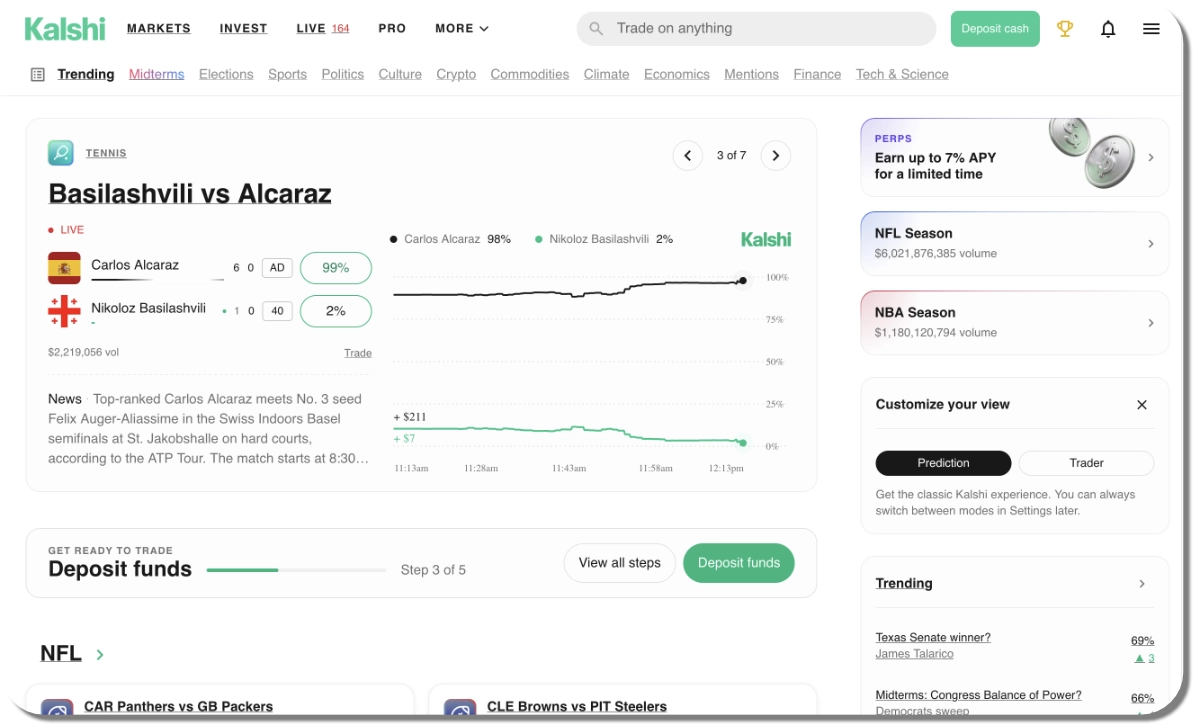
What should you know before joining Kalshi?
Start with the six answers that determine whether this account fits how you bet. Fees and access depend on the particular market; customer experiences are identified separately from published rules.
Is Kalshi a legitimate operator?
Yes. KalshiEX is a CFTC-designated exchange, and Kalshi Klear is a registered clearinghouse. Customers report successful repeat withdrawals, alongside complaints about support and account restrictions. Those registrations are verifiable; they do not establish unrestricted access to every contract in every state.
Does it have the markets you want?
Sports, elections, economics, weather and more. Sports selections include winners, spreads, totals, props and combos—Kalshi’s version of parlays. NFL player markets also include protected picks and payouts based on accumulated statistics. Those products have different settlement rules.
What does a trade actually cost?
At the standard taker rate, 100 contracts at 50¢ cost $51.75 including the $1.75 fee. A normal $100 winning payout leaves $48.25 profit. An early taker sale under that schedule adds an exit fee. Some markets use different rates, and some charge for filled resting orders.
Can you get out before the result?
Yes, when buyers are available and trading remains open. Cash Out starts a sale; it does not guarantee a full exit. A sale can fill partly or fail to fill. A displayed position value is an estimate, not a committed offer for your entire holding.
How and when does it settle?
The contract’s named result source and determination rules control. Kalshi says most markets settle within a few hours, often around three. Some take longer. Canceled events and absent players can produce an assessed-value payout; a refund is not the default for every contract.
How do you get your money out?
US options include bank transfer, debit card, PayPal, Venmo and eligible crypto withdrawals. Cash App is deposit-only. Once money is withdrawable, Kalshi lists bank payouts in a few business days and debit payouts usually within hours. Deposit holds and account reviews come before those delivery estimates.
Is Kalshi worth opening an account with?
Yes. Choose it as your first general-purpose prediction-market account. Its broad event catalogue and trading controls earn positive reviews. As do Kalshi’s market selection, the interface, and sports combos.
Not so much: Support responsiveness isn’t great. Not only did we wait longer than what we find to be standard support response times, but have also found that to be a recurring concerns among other Kalshi users we’ve heard from.
Where does Kalshi differ from its alternatives?
Kalshi’s breadth is useful; its fee structure and settlement treatment deserve comparison. These are specific product differences. They do not establish which provider has the best price for a live selection.
| Feature | Providers | Our assessment |
|---|---|---|
| Pregame sports singles |   |
NoVig charges no trading fee on pregame individual-game singles. Kalshi’s charges depend on the market and order. At equal contract prices, that favors NoVig when Kalshi charges a fee; a better Kalshi quote can change the result. Check NoVig’s markets. |
| Resting-order costs |  |
A Kalshi limit order is not automatically free. Designated markets charge maker fees when resting orders fill. Polymarket US lists no maker trading fee. That makes it worth comparing when you intend to post orders, provided the selection and settlement terms match. |
| Voided parlay legs |  |
Kalshi can keep a disrupted combo leg in the payout calculation at an assessed value. FanDuel Sportsbook removes a voided leg and recalculates the remaining selections under its published parlay rules. Compare FanDuel Sportsbook if that treatment better suits your betting. |
What is the app like to use?
Market browsing, the order ticket and Portfolio are the main areas. One iPhone reviewer praises how easily the interface follows sports, politics and economics; another describes repeated attempts to buy or sell as prices change. The useful distinction is between finding a selection and executing the order you want.
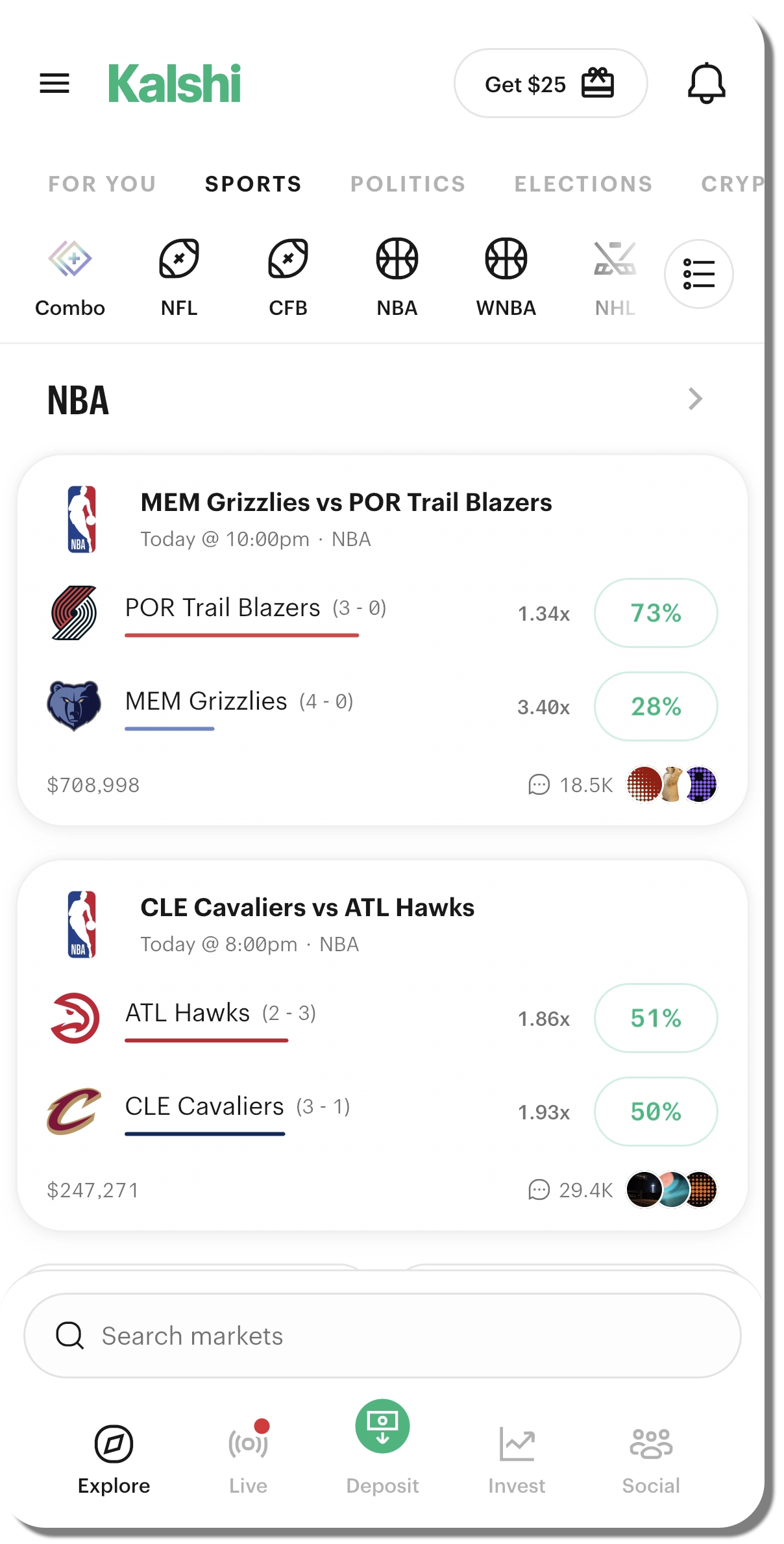
Portfolio combines cash and displayed position value. Cash can itself include nonwithdrawable promotional credit. The amount available to withdraw also reflects holds and account checks. For an open position, Current value uses available bids and estimated selling fees; thin activity can mean it values only part of the holding.
Who operates Kalshi, and who can register?
KalshiEX, LLC runs the exchange; Kalshi Klear, LLC clears trades. Their CFTC registration dates are November 3, 2020 and August 28, 2024 respectively. Individual signup requires 18+, legal adulthood where you live and successful verification. Location and contract-category restrictions also apply.
Which states have restrictions?
Verified court restrictions cover sports in Michigan; sports, elections and entertainment in Nevada; and those categories plus politics, culture, tech/science and mentions in Washington. These are specific examples, not a complete state list. Physical location matters when traveling. Our availability guide and state guide cover access in more detail.
What verification should you expect?
Provide your legal name, birth date and residential address, and verify email and phone. If requested, photograph a valid original driver’s license or passport; a selfie or further evidence can follow. Kalshi’s current guidance says SSN verification is not universally required before depositing or trading, but it can be requested afterward.
What do customers like, and where do they report problems?
Positive accounts emphasize event choice, sports combos and successful withdrawals. Criticism concentrates on support delays, access problems and orders that are harder to complete than the displayed value suggests. These are patterns in the reports reviewed, not measured rates of satisfaction or failure.
The follow-up matters. An October BBB complaint about an unpaid winning position was marked resolved to the customer’s satisfaction that same day. A separate October account-access review described an unresolved software-screening block and slow support. Neither story should be presented as everyone’s experience.
Who gets the most useful account?
Someone who wants games and non-sports events in one place, with control over purchase and sale prices. The breadth is a practical advantage when your interests move between football, elections and economic releases. Limit orders and optional sale targets add ways to manage those positions.
Who should compare another provider first?
Someone choosing solely on the cost of a pregame single, or depending on a rapid early exit. Fee differences matter on short trades. The recent “no buyers” discussion shows why a valuable-looking combo does not necessarily have an available buyer at the displayed amount.
How much control do you have over execution?
Limit purchases set a maximum price; limit sales set a minimum. A quick purchase can consume offers at several prices when the requested amount exceeds the quantity available at the first quote. A limit controls price, while the amount actually matched determines your position.
Can you set a sale target in advance?
Yes. Auto Sell places an optional resting sale at your chosen target after a purchase. It can execute with the app closed, or fill only partly. Manage or cancel it under Orders. Turning off future Auto Sell prompts does not cancel an existing order. Include both trading fees when assessing the target.
What does Kalshi Pro add?
Order-book depth, post-only orders and more expiry choices. Its order panel includes immediate-or-cancel, event-start and custom expirations. Post-only avoids immediately taking an existing offer; it does not waive a market’s maker fee. These controls are documented for Pro, rather than promised on every mobile ticket.
Markets, settlement and the real cost
Which markets make Kalshi worth having?
The range extends from detailed sports selections to elections and economic data. Availability and depth vary by event. The following examples describe the current catalogue, rather than promising identical options for every league or matchup.
Sports: game lines and detailed props
NFL game pages include winners, spreads, totals, team totals, touchdowns, yardage, receptions and first-half markets. The wider catalogue includes basketball, hockey, baseball, soccer, tennis, golf and UFC. Prop depth differs across those sports.
Elections and economic releases
Trade outcomes such as control of Congress, individual races, Federal Reserve decisions, inflation and jobless claims. The contract specifies the release, measurement and deadline. This is the main reason to consider Kalshi beyond its sports offering.
Weather, price events and entertainment
The catalogue includes temperature, rain and snow, crypto-price outcomes, Netflix rankings, Billboard results and TSA passenger counts. Read the named data source: a similar headline elsewhere does not ensure an identical contract.
NFL ladders and Slingshots
These pay according to the player’s statistic, up to $1 per contract. Ladders use fixed increments; Slingshots use increasing steps. They currently cannot be added to combos. Fantasy Ladder has its own rule: no recorded fantasy score means $0 for Yes, rather than an automatic refund.
What happens to ties, scratches and protected picks?
The exact contract determines whether you receive $1, $0 or a partial payout. Kalshi does not apply one sportsbook-style void rule across every product. Four examples show where the difference affects your money.
What happens if an NFL game ends tied?
Without a separate Tie outcome, Yes and No each receive 50¢ under the football-game contract. If Tie is offered, that selection wins and the team selections lose. Overtime counts unless the contract specifies otherwise. Paying 65¢ for a position that settles at 50¢ produces a loss.
Does a postponed game return your stake?
Not automatically. The football-game contract generally keeps a postponed game live if it starts within 48 hours. Outside that window, an assessed fair value applies under its terms. Baseball and other events have their own completion and cancellation rules.
How does a nonplaying combo leg settle?
An ordinary combo multiplies its component settlement values. If an affected leg settles at 0.70 and all others win, a $100 maximum-payout combo pays $70. Another losing leg makes it zero. The affected leg’s own rules decide its value; it is not simply removed.
Does NFL protection mean a refund?
No. Selected protected Yes picks use assessed fair value when their trigger is met. The player must participate before halftime, miss the target and take no play after halftime or in overtime, with play continuing after halftime. Protection must be selected before kickoff and usually costs more.
Protected combos have a separate settlement rule. Kalshi assesses the affected combo’s fair value; the ordinary multiplication example above is not an unconditional rule for protected combos. Any other losing leg still makes the combo lose. Standard NFL player props settle on actual statistics after the player participates in at least one play; injury alone does not activate protection.
What are the fees after buying and selling?
Count both trades if you intend to exit early. The standard taker formula is 0.07 × contracts × price × (1 − price), with price expressed in dollars. Market-specific multipliers alter the charge. Kalshi adds no separate settlement fee.
Using the opening example, 100 contracts bought at 50¢ cost $51.75 including the entry fee. Selling all 100 at 60¢ under the same standard taker schedule incurs $1.68 more. Net sale proceeds are $58.32, leaving $6.57 profit after both fees. This assumes complete fills at the stated prices and excludes funding costs.
Do all sports markets use that rate?
No. At the October 29 check, the MLB game-winner market family used half the standard multiplier, while NFL game winners used the standard multiplier. Those settings are specific to the named markets. The order preview is the relevant price for the selection you are buying.
Does a limit order avoid the fee?
Not necessarily. An immediately matched limit order can be a taker trade, and designated markets charge for executed resting orders. Canceling an unfilled resting order has no fee. Open the “i” beside “You’re buying” to inspect the ticket’s charge.
Check your pick with Book vs Market
Compare available sportsbook and prediction-market prices for the same selection and stake. Then check Kalshi’s final fee, available quantity and settlement wording to see whether its potential return justifies the trade.
Funding, withdrawals and account help
What interest or welcome reward do you actually get?
Predictions currently pays 3.50% variable APY on eligible balances. Welcome and referral rewards are offer-specific: the amount, qualifying activity and deadlines come from the offer attached to your account. There is no single bonus amount promised by the current referral FAQ. Terms checked October 29, 2026.
Interest and a qualifying reward are separate benefits. Neither changes the contract’s trading result. The Predictions rate applies to this account; the separate Perps promotion is not an increased rate for ordinary event-contract balances.
What balance qualifies for interest?
At least $250 average monthly Predictions balance, including eligible cash and positions. Position values move with the market, so a briefly displayed $250 total does not establish qualification for the month.
When is interest paid?
It accrues daily and pays monthly. The calculation uses the portfolio’s value at midnight Eastern. The program is for eligible US and US-territory customers; an SSN is required to receive more than $10 annually in interest.
Four referral details that affect the reward
Where are your actual offer terms?
Explore → menu → Your rewards → Offers. Open the attached offer for the amount, qualifying activity and deadlines before depositing to pursue it.
Can you add a code after signup?
Within 72 hours of account creation, if eligible and no code is already attached. Depositing or trading does not itself close that window.
Does qualifying trigger an automatic payment?
Some offers credit automatically; others require “Unlock bonus.” Adding a code alone does not complete the qualifying activity. Check the reward’s status after meeting its conditions.
Can the reward be withdrawn immediately?
Trading credits are not directly withdrawable. Offer terms specify any trade-through requirement, expiry or product restriction. Use those terms to distinguish a cash reward from credit you must use for trading.
How reliable are withdrawals, and which funding method makes sense?
Customers report successful repeat withdrawals, but account holds and support delays also appear in recent reports. The useful question is which route works for your account and when the money becomes eligible. A recent Cash App complaint illustrates a concrete limitation: it accepts deposits but cannot receive withdrawals.
ACH: what does bank funding cost?
No Kalshi deposit fee; $10 minimum. Full settlement normally takes up to five business days, even if some buying power appears sooner. The Member Agreement requires recently deposited ACH funds to return to the originating bank account for 90 days. That is a destination restriction, not a 90-day ban on withdrawing.
Cards and mobile wallets: what is the charge?
Card deposits have a $10 minimum and cost up to 2%. Apple Pay and Google Pay use the linked card. A $100 deposit can therefore add $2 in processing costs. Credit-card acceptance is conditional, and an issuer’s cash-advance charge is separate.
PayPal, Venmo or Cash App?
PayPal and Venmo support deposits and withdrawals where available; Cash App supports deposits only. PayPal and Venmo start at $10 for deposits, with the first deposit free and later fees varying. PayPal’s published cap is 2%. Cash App charges a deposit fee. Both PayPal and Venmo withdrawals have no Kalshi fee.
What about crypto, wires and RTP?
Crypto withdrawals require a previous crypto deposit. US crypto transfers use Zero Hash; inspect the quote for provider or network costs. Wire deposits start at $1,000. RTP offers a faster bank-deposit route where supported. Neither the availability of a deposit method nor a quick deposit guarantees an identical withdrawal route.
When does the money reach you?
How long does a bank or debit payout take?
Kalshi lists a few business days for bank withdrawals and usually a few hours for debit cards. Both have no Kalshi withdrawal fee. A debit-card processor review can take 3–5 business days. Those delivery estimates apply after the funds are available to withdraw.
Why is some cash unavailable?
Deposit clearance, security holds and nonwithdrawable credits affect the available amount. The withdrawal screen shows the release time. Earnings above original deposits become available once they are settled cash; the original deposit’s hold remains separate. Open positions must be sold or settled before their value becomes cash.
What happens when you need help?
Use menu → Get help → Chat with support while logged in. If you cannot access chat, email [email protected] from your registered address. Chat begins with automated assistance and escalates where needed; there is no phone or text-message support. Recent users describe slow human responses, which matters when an open position or withdrawal needs attention.
What if a market has not paid out?
Check its determination time and named result source. For an ordinary market still pending after roughly 12 hours, contact support unless its rules specify a later determination. Request to Settle asks the markets team to review a pending outcome; it does not guarantee immediate settlement or reverse a completed result.
Where can you download records?
Use Documents on the website and the date-range export in Your activity. Keep trades, settlements, credits, transfers and fees together when checking a disputed balance. For an execution problem, include the market and order IDs, fill price, quantity and timestamp in the support request.
Can you cap monthly deposits?
Yes. A personal funding cap limits deposits per calendar month. A new cap applies immediately; an increase takes effect the following month. Wire deposits are unavailable while a personal cap is enabled. The cap controls funding rather than the market value of existing positions.
Can you still sell during a trading break?
No. Trading breaks and self-exclusion also block selling existing positions. That restriction matters if you are holding contracts you planned to exit early. A direct Kalshi restriction does not automatically apply to access through a separate brokerage account.
Which alternative is a better fit for you?
NoVig is the relevant fee comparison for pregame singles; FanDuel Sportsbook offers conventional parlay treatment. Use Book vs Market to compare available returns, then choose on the actual price and rules for your pick.
NoVig
Compare it for pregame individual-game straight trades without a trading fee. Its focus is sports, so it serves a narrower purpose than Kalshi. The fee advantage matters only alongside the quote and quantity you can actually trade; its live and parlay pricing follows different rules.
FanDuel Sportsbook
Compare it if you prefer voided parlay legs removed and the remaining odds recalculated. Kalshi’s assessed-value settlements are a material difference for that type of bettor. FanDuel’s sport-specific rules still apply, and you need access to its sportsbook in your state.
Read our FanDuel Sportsbook review · Visit FanDuel Sportsbook
Should you open a Kalshi account?
Kalshi earns a place on the shortlist for its combination of sports, non-sports markets and price controls. The customer evidence supports that appeal while giving clear reasons to scrutinize support, exit liquidity and payment access. It is a stronger choice when you will use the wider catalogue than when you simply want another place for pregame singles.
Find your selection in Book vs Market and compare the available prices for your stake. Include Kalshi’s entry fee and any planned exit fee. For props or combos, make sure the participation and cancellation rules fit the bet you intend to place.
Kalshi FAQs
Six final answers to common account and trading questions.
Do you need cryptocurrency to use Kalshi?
No. US customers can use bank transfers and supported card or payment-service methods. Crypto is optional; it is not required to buy event contracts.
Can you cash out every combo?
No guaranteed early exit exists. Check the position’s executable sell quote and the quantity it covers. A filled combo cannot simply be canceled, and no available buyer means no completed sale.
Does posting a limit order make the trade free?
No. Some markets charge maker fees when resting orders execute. A limit order that immediately matches an offer can also incur the taker fee.
Does a protected NFL pick refund the stake?
No. An eligible protected pick uses assessed fair value when its conditions are met. Protection does not automatically return what you paid, and it must be selected before kickoff.
Why can you deposit with Cash App but not withdraw to it?
Kalshi supports Cash App for deposits only. Choose another eligible payout method. The ability to fund through a service does not establish that it can receive a withdrawal.
Is every Kalshi market available throughout the US?
No. Category restrictions exist in states including Michigan, Nevada and Washington. Eligibility for an account does not grant access to every sports or non-sports contract.