
Robinhood Event Contracts is a good choice for existing Robinhood customers who want sports predictions alongside their investing account. You buy an outcome, pay the displayed price and fees, then sell before settlement or hold for the result. The strongest advantages are familiar account management, dollar-based orders and access to several exchanges through one app. The important limitation: event trading is mobile-only; the website is view-only and Robinhood Legend does not support it.
Our verdict: use Robinhood for convenience, but compare the complete price before making it your regular sports platform. A hypothetical 100-contract purchase at 50¢ costs $52 on the Kalshi route under the fee assumptions below, leaving $48 profit on a normal $100 winning payout. The six answers below cover legitimacy, markets, costs, exits, settlement and withdrawals first. Check our Book2Market to compare odds across multiple prediction markets and sportsbooks to find the best price for the event you want to trade.
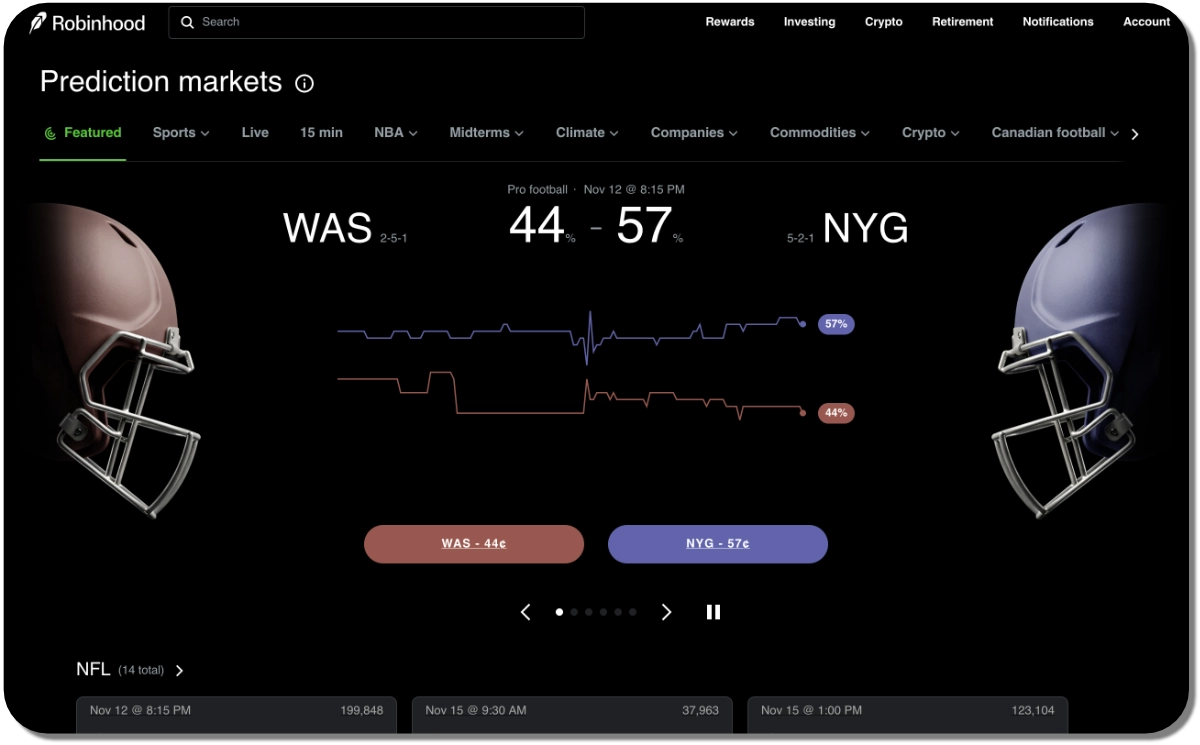
What should you know before using Robinhood Event Contracts?
Robinhood is the broker through which you trade; the exchange behind each contract supplies its market and settlement rules. That distinction explains the charges, the available exit and who determines your result.
Is Robinhood Event Contracts legit?
Yes. Robinhood Derivatives, LLC is a CFTC-registered futures commission merchant and NFA member. Its partners include Kalshi, ForecastEx, Rothera and the exchange infrastructure associated with OG/Crypto.com. Event contracts sit in the derivatives service, not the securities account: Robinhood Derivatives is not FDIC-insured or SIPC-protected. That’s separate from protections attached to other Robinhood products.
Which markets can sports bettors trade?
Game outcomes, spreads, totals, player selections and eligible multi-leg Combos. Political, economic and other events also appear in the catalog. For a standard $1 contract, a correct outcome pays $1 and an incorrect outcome pays zero. The exact line, period and settlement conditions are available on the event page.
What does a 50¢ contract actually cost?
In our 100-contract Kalshi-route example, the total is $52: $50 for the contracts, $1 Robinhood commission and $1 exchange fee. A normal winning settlement pays $100, so profit is $48. Both Gold and non-Gold customers reach the commission cap at this price. Other exchanges can have different charges; this is a worked example, not a live quote.
Can you sell before the game finishes?
Yes, if the market is open and buyers accept your closing order. Go to Investing → Prediction markets → Your positions → Close position. A displayed position value is not a guaranteed sale. The available buying price, quantity filled and exit fees determine your proceeds. A Combo needs a quote for the combined position rather than separate sales of its legs.
Who decides whether the contract wins?
The listing exchange applies the contract’s result source and rules. Robinhood processes the resulting payout. Open the event’s About section for the terms and Timeline for expected resolution and payment. Cancellations and inactive players can produce nonstandard settlements, so a sportsbook-style refund is not a universal rule.
When can you withdraw a winning payout?
Robinhood generally makes payout proceeds withdrawable within one business day after settlement. Then the chosen bank-transfer timetable applies. Standard ACH is free; eligible instant withdrawals charge 1.75%, with a $1 minimum and $150 maximum fee. Pending deposits and account holds can delay access independently of the match result.
Is Robinhood worth choosing for sports prediction markets?
Yes for an existing customer who wants occasional sports trades without maintaining another unrelated login and bank connection. That is a real convenience advantage. You still need derivatives approval and sufficient event-contract buying power, but your account administration remains in an app you already use. For a recreational bettor, simple sizing and accessible records can matter more than advanced trading screens.
For a new customer interested mainly in pregame singles, we recommend comparing Novig first. Its published fee-free pregame straight trades beat a charged Robinhood entry at an identical executable price. Frequent traders should also compare Kalshi’s direct fees. Robinhood is not our recommendation for a desktop-first setup; its website does not accept these orders. Choose it for the account experience, not an assumption that a familiar stock-trading app must also offer the lowest sports-trading cost.
How does Robinhood compare with other prediction markets?
OG, Novig, Kalshi and Fanatics Markets give you different reasons to compare their prices with Robinhood. OG’s sports-trading fees are particularly competitive on lower-priced contracts; Novig offers fee-free pregame singles; and trading directly with Kalshi uses a different fee schedule from accessing its contracts through Robinhood.
The examples below compare purchases of 100 contracts at an identical execution price. Robinhood calculations use its published commission cap and the additional 1¢-per-contract exchange fee for its Kalshi route. These are hypothetical comparisons, not live quotes. Funding costs, withdrawal charges and the cost of a Gold subscription are excluded.
| Feature | Compare with Robinhood | Our assessment |
|---|---|---|
| Lower-priced sports contracts |

|
OG is cheaper in this 10¢ sports-contract example, including against Robinhood Gold. Buying 100 contracts through an immediately matched OG order costs $10.63: $10 for the contracts and 63¢ in trading fees. Robinhood costs $11.90 without Gold or $11.45 with Gold under the exchange-fee assumption above. OG therefore saves $1.27 or 82¢ on the same purchase. Both holdings normally pay $100 if the selected outcome wins. Compare the actual price and available quantity alongside that fee advantage. Check OG’s markets. |
| Pregame sports singles |
|
Novig charges no trading fee on pregame straight trades through its app or website. At 50¢, 100 contracts cost $50 at Novig versus $52 at Robinhood under the stated fee assumptions. A normal winning settlement returns $100 on either platform: $50 profit at Novig compared with $48 at Robinhood. For a bettor concentrating on pregame singles, Novig is the stronger choice at matching prices. Live trades, futures and parlays have separate fee treatment. Compare Novig. |
| Direct exchange access |

|
Kalshi’s standard direct taker fee for 100 contracts at 50¢ is $1.75, producing a $51.75 purchase compared with Robinhood’s $52. Direct access saves 25¢ in that example. The advantage changes with price: at 90¢, Kalshi’s standard fee is 63¢, producing a $90.63 purchase versus Robinhood’s $91.90 without Gold or $91.45 with Gold. Trading on the same exchange through different accounts does not mean paying the same fees. Market-specific schedules and resting-order treatment also matter.Compare Kalshi directly. |
| Buying a short-priced favorite |
 |
Fanatics Markets publishes a maximum trading fee of $1.60 for 100 contracts at 90¢, giving a $91.60 total. That’s 30¢ below Robinhood without Gold, but 15¢ above Robinhood with Gold in the comparison above. For an existing Gold subscriber, Robinhood wins that particular comparison if Fanatics charges its published maximum. For a non-subscriber, Fanatics is cheaper. Use the actual order-preview fee, and count the subscription cost separately when deciding whether Gold is worthwhile. Check Fanatics Markets. |
What is the Robinhood app and desktop experience like?
Use the mobile app to place orders; use the website to research and view markets. Search for Prediction markets, open an event, and inspect the question before choosing Yes or No. The review screen shows the proposed position, price and charges. Dollar sizing suits a fixed budget; contract sizing suits a fixed payout target. This assessment follows the documented controls, not a timed test of a funded account.
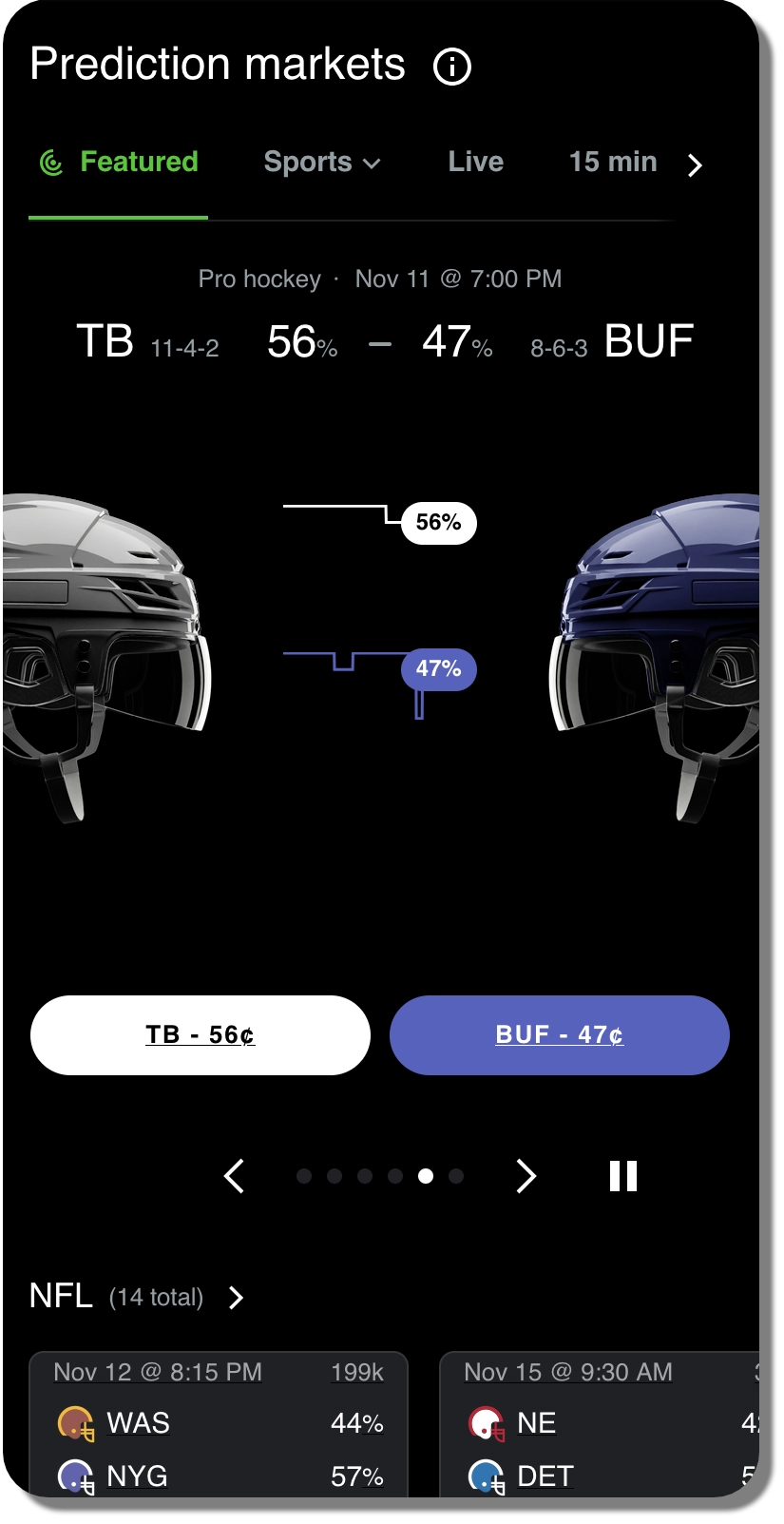
Robinhood says its Realized profit & loss view excludes them. That matters when small price movements are your trading strategy. Find the view under Investing → Realized profit & loss → Prediction markets, then reconcile it with Account → History → Event contracts, where trades, payouts and fees appear. A positive gross trading result can become a loss after repeated entry and exit charges.
Who can open an account, and how established is the product?
You need an approved individual Robinhood investing account and separate Robinhood Derivatives approval. Current eligibility includes US residency and a minimum age of 18. Robinhood introduced election contracts in October 2024 and its broader prediction-market hub in March 2025. Rothera routing began in June 2026, followed by the OG/Crypto.com exchange connection in September; this is no longer solely an election feature or a Kalshi-only connection.
Do existing Robinhood customers get automatic access?
No. The derivatives application is a separate approval. Start from a prediction’s event page and select a side to enter onboarding. Robinhood assesses your investment profile, experience and eligibility. Complete that step before funding specifically for a game. A rejected application or an attempt to re-enable previously disabled access can trigger a 30-day reapplication interval.
Which location restrictions matter?
Both residency rules and your detected location can affect trading. Robinhood expressly lists sports restrictions for Maryland, Michigan and Nevada residents, and restrictions on opening new sports positions for Ohio and Utah residents from November 2, 2026. It warns that further limits can apply. Use our state guide alongside the availability in your account; an accessible investing account does not establish sports-contract access.
What do customer reports reveal about reliability?
The relevant reports concern trade execution and the ability to exit, not Robinhood’s stock-trading reputation. In a prediction-market discussion during the 2026 midterms, customers described frozen prices, rejected orders and difficulty selling. Those are firsthand reports, not audited evidence of the cause, duration or frequency of an outage.
We have not placed a funded trade or measured Robinhood’s payout speed. The reports below identify questions to investigate; they do not establish a failure rate or prove that every canceled order is a platform malfunction.
What did the affected traders describe?
Several participants said they could not close positions while prices were moving. One reported rejected college-football orders while other contracts still worked; another said a service-warning banner appeared. Commenters offered conflicting explanations about the exchange involved. We did not independently establish the root cause or a final resolution, so we do not present those explanations as findings.
How can you distinguish an outage from an unfilled order?
Check the order record and market status before submitting a replacement. Robinhood documents automatic IOC cancellations when no counterparty accepts the price. That is different from a filled order disappearing or an acknowledged service incident. Capture the contract, timestamp, status and error message. Those records let support determine whether the problem involved matching, an account restriction or a technical failure.
How do orders behave when prices move?
Immediate-or-cancel orders prioritize a prompt match; good-til-date limits let you name your price. For frequent bettors, the distinction determines how much actually gets bought, how long cash stays committed and whether an intended exit remains working.
What happens if only part of the order fills?
You own the filled quantity, not the amount originally requested. In a hypothetical 100-contract IOC order with 40 matched, the other 60 cancel. A working limit can leave those 60 pending instead. Canceling that remainder does not reverse the 40 already bought. Use Investing → Prediction markets to open a pending order and request cancellation; confirm its final status before replacing it.
Will a limit order stay open until next weekend?
No. Robinhood’s event-contract GTD orders expire at 3 a.m. Eastern the next calendar day. A Monday order will not wait all week for Sunday’s price. Pending orders also reserve buying power, so an unused limit can explain an unexpectedly low available balance. Schedule the order around the period in which you actually want exposure, then review anything left pending.
Markets, settlement and the real cost
Which markets and tools make the account useful?
Robinhood combines familiar sports propositions with events that a sportsbook may not list. The useful test is whether you can find your precise outcome at a price and quantity you would accept—not simply whether a league or category appears in the menu.
Does the sports menu extend beyond game winners?
Yes. The documented offering includes spreads, totals, player outcomes and futures. Robinhood’s football and World Cup launches illustrate the expansion into match results, tournament progression and individual achievements. Those markets can come from different exchanges. Read the period and settlement source beside the price, particularly when comparing a regulation-time result with a team-to-advance selection.
Can you build your own sports Combo?
Yes: supported events allow custom combinations of up to ten legs. These trade as one contract. A fill-or-kill order either fills the requested Combo quantity or cancels; you cannot sell one troublesome leg separately. Robinhood also warns that its app can accept conflicting selections. Review the complete proposition before submission rather than relying on the builder to catch every incompatible combination.
What can you trade outside sports?
The public catalog includes elections, economic releases, commodity prices and cultural events. That adds uses during the sports offseason without requiring another account. For a price or economic-release contract, locate the named observation time and data source. The date on a news story and the value used to settle your contract need not describe the same measurement.
How do dollar orders help a fixed-budget bettor?
You enter a spending amount and the order calculates the quantity after fees. This is different from requesting, for example, 100 contracts and accepting the resulting total cost. At a hypothetical fee-inclusive price of 52¢, a $20 budget buys 38 whole contracts and leaves 24¢ unused. Actual quantity depends on execution, and some markets support fractional contracts.
Which settlement rules can change your payout?
The contract’s exchange rules decide the outcome, including exceptions. Find them under About. These examples show why an apparently familiar wager can settle differently from the ticket at your usual sportsbook.
Does a canceled game guarantee a refund?
No universal refund rule applies. The exchange can specify a refund, zero or another settlement value. Before a weather-sensitive event, check the contract’s postponement deadline and cancellation provision rather than assuming every Robinhood sports contract follows one house rule.
What happens when a Combo leg is voided?
A nonstandard leg value can reduce the entire payout. Using Robinhood’s example, two legs at 50¢ and two at $1 produce 25¢ per Combo contract. One hundred such contracts pay $25, even though none of the four legs settles at zero.
What if the player does not participate?
The relevant exchange’s participation rule controls. Robinhood describes possible voids or fallback values such as 50¢. A holding bought at 70¢ and settled at 50¢ returns less than the contract cost. The exchange and exact player market matter.
Does “25+” mean the same as “over 25”?
No: 25+ includes exactly 25; over 25 requires more. That one-point boundary determines the result. At 25 points, a qualifying 25+ Yes contract wins while a strictly-over-25 Yes contract loses. Use the full definition shown with the contract.
The final whistle and the payout time are separate milestones. The event’s Timeline shows its expected resolution and settlement. When reviewing a disputed result, save the exchange’s rule and named data source alongside the ticket. Robinhood says it cannot override the exchange’s determination. Our prediction markets vs sportsbooks guide explains the broader comparison.
What do buying and selling cost after Robinhood’s fees?
Robinhood’s commission uses k × P × (1 − P) × C, capped at 1¢ per contract and rounded up to a cent. P is the dollar price, C is quantity, and k is 0.10 without Gold or 0.05 with Gold. Add the applicable exchange fee. The calculations here use 1¢ per contract for the Kalshi route and assume a single fill at the stated price.
A 50¢ purchase followed by a 60¢ sale earns $6 on 100 contracts in this example. Entry costs $52; the sale returns $60 less $2 in charges, or $58. Subtracting the $52 entry leaves $6. Both tiers hit the commission cap at both prices. Holding to a normal winning settlement instead returns $100 and leaves $48 profit. That $52 entry implies a 52% break-even win rate, rather than the 50% suggested by the contract price alone.
Does using a limit order automatically remove the commission?
No. Robinhood’s schedule charges executed contracts; it does not advertise a separate commission-free maker tier. The reason to use a patient limit is control over your entry or exit price. A 1¢ improvement across 100 filled contracts saves $1 before any fee change—an amount worth comparing with the charge itself.
Can the spread matter more than the explicit fee?
Yes. The buying price and the available selling price can be several cents apart. Hypothetically, buying 100 at 50¢ and immediately selling at a 47¢ bid loses $3 on price alone. With $2 charged on each side in this scenario, the total loss is $7. Compare the sale proceeds for your full quantity, not just a portfolio valuation.
Compare your Robinhood trade with Book vs Market
Find your event and match the selection, line and settlement period. Compare the providers returned by Book vs Market with Robinhood’s own fee-inclusive order preview. Robinhood is not guaranteed to appear in the tool’s results; where it is absent, compare its quote alongside the tool rather than treating the provider list as complete.
Funding, withdrawals and account help
Do promotions or Robinhood Gold improve the value?
The ongoing event-trading benefit is Gold’s lower commission calculation, not a verified sportsbook-style welcome bonus. We did not find current public event-contract signup-credit terms in the official material checked on November 11, 2026. Brokerage stock rewards are a different offer; the historical World Cup commission promotion should not be advertised as a current football incentive.
Our recommendation is to value Gold against the prices and quantities you already trade. It is optional. The subscription becomes useful through actual savings or other benefits you already use—not by increasing your trading volume to justify it.
How much does Gold cost?
$5 per month or $50 per year under Robinhood’s current published plans. Eligible customers have a one-time 30-day subscription trial. Paying for Gold does not buy contracts, insure positions or eliminate exchange fees. Its event-contract discount is one benefit within a broader investing subscription.
Does the World Cup referral offer still apply?
Do not treat the June 2026 campaign as a standing signup offer. Robinhood announced a World Cup-specific zero-commission benefit for referring five friends. That announcement establishes a past promotion, not a current reward on every event. Likewise, a brokerage referral-stock reward carries its own conditions, including a 30-day cash-withdrawal restriction.
Four checks before paying for Gold just for prediction markets
Will Gold save money on 50¢ contracts?
No commission savings in the published 100-contract example. Both formulas reach the $1 cap. Adding a $1 exchange fee makes the purchase $52 either way. For someone trading mostly near-even-money outcomes, the lower headline coefficient alone is not a reason to subscribe.
Where does the discount produce a real difference?
At 90¢, Robinhood’s commission on 100 contracts falls from 90¢ to 45¢. With a $1 exchange fee, total entry becomes $91.45 instead of $91.90. That is a 45¢ saving on that transaction, not half off the complete cost.
How much of that activity covers a $5 month?
Twelve 100-contract transactions at that same 90¢ price save $5.40 in commission. That calculation isolates the discount and assumes the same exchange charge for both tiers. Different prices, quantities and rounding change the result. Count activity you already intended to place, rather than buying extra positions to reach it.
What happens at the end of the trial?
The selected paid subscription starts after the eligible trial ends. Compare its cost with the savings you actually received and the other benefits you used. A contract profit or loss remains separate from subscription value: Gold can reduce a charge while the trade itself still loses.
How do you fund event contracts and withdraw proceeds?
Fund your Robinhood account in dollars and check the event-contract buying power on the order ticket. Automatic movements connect the brokerage and derivatives balances. The dedicated funding guide says Instant Deposit access is not always available for event contracts, so plan around settled cash rather than the larger number displayed for stock trading.
What is the low-cost standard funding method?
A linked-bank ACH deposit carries no Robinhood transfer fee. Use Account → Menu → Transfers → Deposit. Standard deposits can take up to five business days. For a weekend game, funding early avoids turning the transfer timetable into a last-minute decision about which market to trade.
Can a debit card fund the account faster?
Eligible debit-card deposits are fee-free at Robinhood and typically arrive within 30 minutes. Bank verification or processing can extend that estimate. Your account’s limits appear before confirmation. Once credited, inspect event-contract buying power; the transfer arriving and the intended derivatives order being eligible are separate account checks.
What about an incoming bank wire?
Robinhood charges no incoming wire fee and publishes same-day arrival when your bank initiates before 4 p.m. Eastern. Later wires normally arrive the next business day. Use the account-specific instructions in Transfers and allow for any fee charged by your own bank. Additional review can extend the timetable.
Why can a winning position leave buying power unchanged?
An unrealized gain is not additional spending cash. Robinhood credits funds after the position closes or pays out. Pending orders can also reserve cash. Review the event-contract balance rather than assuming every dollar in the portfolio valuation is available for the next order; brokerage buying power can update on a different schedule.
When proceeds are withdrawable: standard or faster transfer?
How do standard ACH withdrawals work?
Go to Account → Menu → Transfers → Withdraw and select the receiving bank. Standard ACH is free. Robinhood’s transfer table lists one day of its own processing, with additional time possible at the receiving bank. That clock follows settlement and withdrawal eligibility. Check the account’s displayed withdrawable cash and transfer limit before planning payment.
What does an instant withdrawal cost?
1.75%, with a minimum fee of $1 and a maximum of $150. A $1,000 withdrawal therefore costs $17.50. Supported debit-card or real-time bank routes are listed with processing up to 30 minutes, subject to eligibility and review. The convenience fee changes transfer speed; it does not clear a pending deposit or unsettled contract sooner.
How do you get help with an account, trade or withdrawal?
Use Robinhood’s in-app support for an account-specific event-contract problem. Chat is advertised 24/7. Eligible callback support for investing features runs 7 a.m.–9 p.m. Eastern, Monday through Friday excluding holidays; not every inquiry qualifies. We have not measured response times. Identify the product as Robinhood Derivatives / event contracts so the agent has the right account context.
What should you send with a disputed settlement?
The contract identifier, exchange, filled quantity, accepted price and settlement reference. Add the relevant wording from About and the official result source specified there. Ask support to distinguish an exchange determination from a missing cash credit. Correcting an account-processing error is a different task from changing the underlying event result.
What should you do when an order keeps failing?
Check approval, the contract’s trading hours and available buyers first. Robinhood’s troubleshooting guide also recommends restarting the app and installing updates. A location restriction or a pending tax-ID notice can block trading even when cash is available. Send the exact error and timestamp; repeated attempts without reviewing the order history can make the account harder to reconcile.
Which account-security controls are useful?
Robinhood documents passkeys, device approvals and device monitoring. Review them before relying on the same login for both investments and event positions. Its support system identifies callback details through notifications. Use that account-based route for a sensitive query rather than a phone number supplied by someone replying to a public complaint.
Can you stop event trading without closing the whole account?
Yes. Contact support about event-contract self-exclusion. Hiding sports markets or turning off notifications is a different control and does not itself prevent trading. Open positions must be addressed before the event-contract account is fully disabled; balances transfer back after settlement. Keep the withdrawal and trade records you need before completing the process.
Which alternatives should you compare with Robinhood?
Novig is our first comparison for pregame sports singles; Kalshi is the direct-exchange comparison. The question is whether Robinhood’s convenience offsets a different fee, market selection or execution price. Use Book vs Market for the supported comparisons, then check each platform’s complete order.
NoVig
Choose Novig over Robinhood when identical pregame straight trades are available at the same price and fee savings are your priority. Its no-fee treatment for those app/web orders gives a clear comparison. Live trades and futures require their own fee check. A better contract price or more available quantity elsewhere can still outweigh the fee difference.
Kalshi
Compare Kalshi directly when you want an exchange-focused account rather than brokerage integration. Its direct fee schedule is separate from Robinhood’s. The ordinary taker example saves 25¢ on 100 contracts at 50¢; that is a measured comparison, not a claim that every Kalshi market is cheapest. Match the contract and available size before choosing.
Should you use Robinhood Event Contracts?
Yes when you already use Robinhood, prefer mobile trading and value keeping account administration together. It offers a credible route into sports and other event contracts, with price-controlled orders and a clear transaction record. We would choose a different setup for desktop-first trading, and compare Novig first for regular pregame singles at matching prices. The decision comes down to the account workflow and full order cost—not the strength of the Robinhood brand alone.
Match the outcome, inspect the fee-inclusive entry and check the available exit for your quantity. Then look at when the cash becomes withdrawable. Those checks connect the price on the screen with the money that can return to your bank.

Explore Robinhood’s current event contracts
Browse the market, then use the mobile app to review the complete order.
Robinhood Event Contracts FAQs
Six practical answers on the account requirements, price display and records you will use after trading.
Do you need cryptocurrency to use Robinhood predictions?
No. These event contracts use dollar funding and cash settlement. A crypto account or token purchase is unnecessary. The relevant approval is for Robinhood Derivatives, alongside the required individual investing account.
Is Robinhood Gold required?
No. Eligible non-Gold customers can trade event contracts. Gold changes the commission calculation, not the outcome or normal $1 settlement value. Its subscription is optional, and at some prices the cap produces the same commission for both tiers.
Can you trade event contracts on Robinhood Legend?
No. Current support documentation excludes Legend and limits web access to viewing. Place and manage these trades through the mobile app. Someone who keeps all their trading on desktop should resolve that workflow mismatch before opening an account for predictions.
Can support undo an accidental filled order?
No. A completed trade cannot simply be reversed. An unfilled order can be canceled; a purchased holding requires an available closing trade or settlement. An early sale can produce a gain or loss and another fee.
Will the usual brokerage tax form include these trades?
Robinhood currently says it does not issue a 1099 for event-contract trades. It supplies a separate annual statement showing transactions and fees. Save that record for tax preparation; the absence of a 1099 does not establish that profits are tax-free.
Where can you see what was actually charged?
Account → History → Event contracts shows trades, payouts and fees. The Realized profit & loss screen excludes fees, according to Robinhood. Reconcile that display with the transaction history and annual statement to measure the amount you actually earned or lost.