
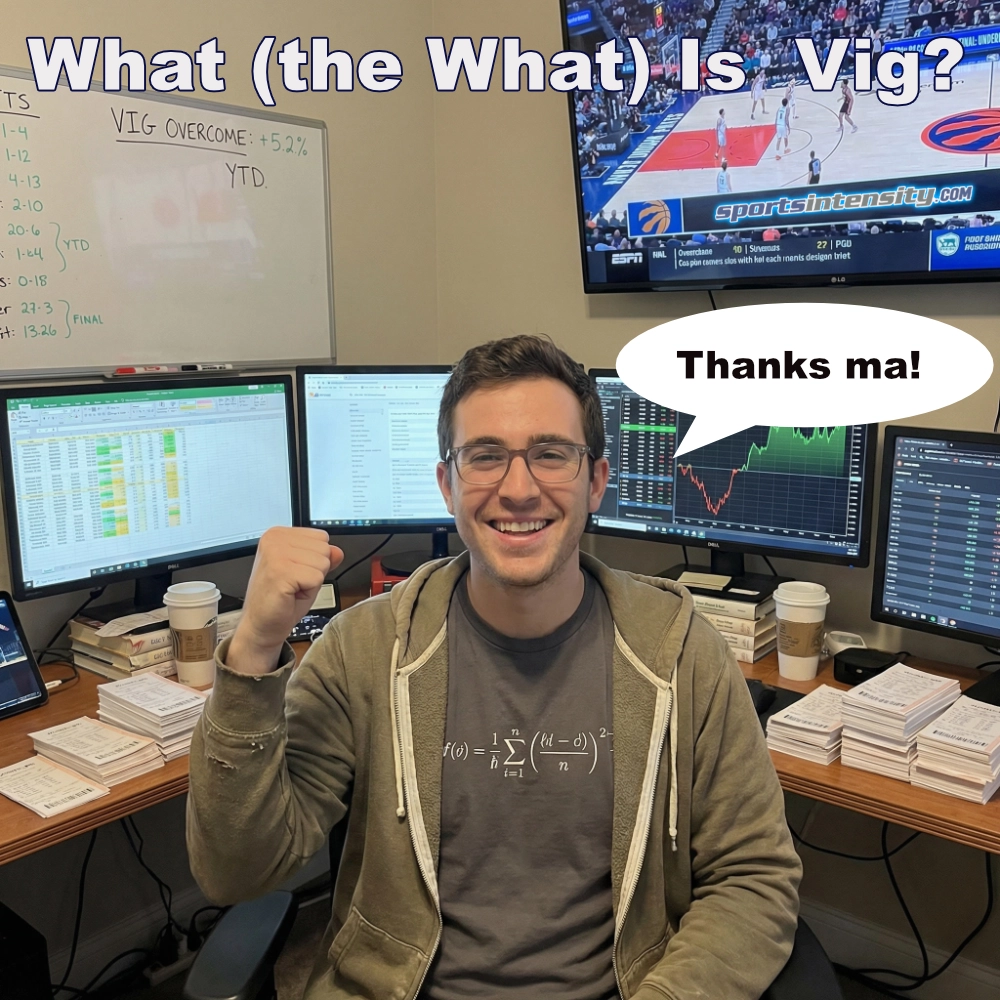
What is vig? Before I got serious about sports betting, that was a question about one of the obscure, jargon-y phrases that I knew separated the sharks from the whales. If you knew what vig meant, then you probably also knew what the inside of the smoky back room of a bar on the wrong side of the tracks smelled like. Even after I learned that vig was short for “vigorish” — is that like a really energetic radish? — I wasn’t any closer to knowing. Eventually I got my head wrapped around it. It took a while (though I’m probably not the sharpest tool in the shed) and once I did, I was a whole lot smarter about betting.
In essence, the vig (aka the juice) is the sportsbook’s profit baked in to every number you see. Just because it’s baked in doesn’t mean it’s smoky, or shady, it’s just one of the costs of us bettors trying to get something for nothing. The vig lives in the odds, which means it’s a cost on every bet that you will need to overcome in order to profit on those bets. For anyone who wants to move beyond guesswork and emotion and into disciplined sports betting, understanding vig is fundamental — because it tells you exactly how much you have to overcome just to break even.
The Juice Will Drip You Dry
At its simplest, vig is the difference between what a fair market would pay and what the sportsbook’s market actually pays. In a perfect world (ignoring house cut), the two opposing sides of a bet would add up to a 100% probability: a 50/50 coin toss. But in practice, once you convert real posted odds into implied probabilities, those numbers almost always sum to more than 100%. That extra percentage point is the bookmaker’s margin — the vig. When you see odds priced in a way that suggests more than a 100% probability, you are looking at the price plus the house’s cut.
Example 1: The Vig on a Spread Bet
To bring this to life, let’s look at a real, verifiable example from the upcoming Super Bowl LX using odds for a spread bet from Bovada lv, one of our best offshore sportsbooks for us bettors as an example. Bovada’s odds favor Seahawks over the Patriots with a spread around Seahawks –5. (as of today, mind you, this can and frequently does change).
When you look at the spread market for that game, both sides are typically listed at –110 — that is, you must risk $110 to win $100 on either side of the spread. Convert those -110 odds into implied probability and you get:
- Implied probability of -110 = (110 / (110 + 100) = 52.38%)
- Two sides of the market: (52.38% + 52.38% = 104.76%)
That 104.76% tells you something crucial: you’re paying a vig of 4.76% on that market. The fair probability (without vig) would be 100%; anything above that number is profit the sportsbook expects to keep, assuming balanced action on both sides. The vig here isn’t incidental — it’s baked directly into the price you see and the way payouts are structured.
Why does that matter? Because it changes how you assess value and risk. On a pure coin flip — a fair 50/50 outcome — you only need to win half your bets to break even. But on a -110 spread, you need to win about 52.38% just to cover the built-in vig. That difference might seem small on a single wager, but over dozens or hundreds of bets, it’s the margin that separates winners from losers. In an NFL season where a sharp bettor might have 150–200 bets, shaving even a few percentage points off the vig through line shopping or smarter market selection can have a meaningful impact on profitability.
Let’s make that concrete. Say you bet 100 Seahawks –5 at -110 over the course of a season. If you win exactly 52 games and lose 48, you’ve won more than a pure 50/50 rate — but you haven’t broken even because of the vig: your actual break-even threshold was closer to 52.38 wins. In practical terms, that small vig, applied repeatedly, erodes edge if you aren’t accounting for it.
The physics of vig also explain why sportsbooks love balanced books. A sportsbook’s ideal scenario is simple: equal action on both sides of a market. If half the handle is on the Seahawks and half on the Patriots (against the spread), the sportsbook’s risk is neutral, and the vig is pure profit. That’s how bookmakers stay solvent year after year — by pricing lines that encourage balanced action and by embedding a margin that ensures they don’t need to guess the outcome correctly to make money.
Here’s the moneyline side of the same Super Bowl example, worked cleanly and transparently so you can see how vig shows up when the prices aren’t symmetric.
Example 2: Vig on a Moneyline
Let’s use the Seahawks vs. Patriots Super Bowl matchup you referenced, with a moneyline of:
- Seattle Seahawks –240
- New England Patriots +200
First, convert each side into implied probability.
For negative odds (–240):
For positive odds (+200):
Now add them:
That total—103.92%—tells you the vig on this moneyline market is:
So even though the Seahawks are the heavy favorite and the Patriots are the underdog, the sportsbook has still embedded a 3.92% house edge into the two prices taken together.
To see how that plays out in dollars, imagine $10,000 in total bets split evenly between the two sides:
- $5,000 on Seahawks –240
- $5,000 on Patriots +200
If Seattle wins:
- Seahawks bets pay profit of
- The sportsbook pays out $7,083.33 (winnings + stake) to Seattle bettors
- It keeps the $5,000 from Patriots bettors
- Net hold = $5,000 − $2,083.33 = $2,916.67
If New England wins:
Patriots bets pay profit of
The sportsbook pays out $15,000 (winnings + stake) to Patriots bettors
It keeps the $5,000 from Seahawks bettors
Net loss = $10,000 − $5,000 = $5,000
That looks asymmetric because we assumed equal money on each side; in practice, books shade prices (like –240/+200) to attract action toward balance. When action is balanced, the 3.92% vig is what remains on the table over time, just as the 4.76% we saw on the –110 spread.
What is Vig? Know It and Own It
Vig varies depending on the market. Moneyline markets often carry different margins (we get into a moneyline bet example below), and futures and prop markets can have even higher hold percentages because more than two outcomes are priced. But the conceptual structure remains the same: vig is the extra percentage above 100% total implied probability that makes the bet profitable for the bookmaker in the long run.
For bettors who are serious about bankroll survival and optimizing profit, vig isn’t an abstract concept — it’s the baseline you build your expectations against. Knowing how to read implied probabilities helps you judge not just whether a bet is “worth it” in your own estimation, but whether it has the pricing room to be profitable after the sportsbook’s cut.
Understanding vig also makes line shopping and market selection more than just slogans — they become quantifiable levers. If one book offers a spread at -108 instead of -110, that’s a lower implied vig and a slight improvement in your break-even threshold. Over a season, those tiny improvements accumulate because vig is an embedded cost you pay every time you place a wager.
In the end, vig is not a tax you pay once — it’s a tax embedded in every bet. It doesn’t matter whether you’re wagering a casual $25 teaser or a high-volume season bankroll: the house margin is there, quietly in the math, affecting your break-even conditions. The sportsbooks don’t need to pick winners to make money; they just need to price bets so that the sum of their implied probabilities exceeds reality. Knowing that, and knowing how to calculate the vig on any number you see, is part of what separates the thoughtful, analytical bettor from the recreational punter.
The key takeaway is that vig is always there, whether you’re betting a neat two-way spread or a lopsided moneyline. The prices might look different, but when you convert them into implied probabilities and add them up, anything above 100% is the sportsbook’s cut—and that cut is what you must overcome to be a winning bettor.