
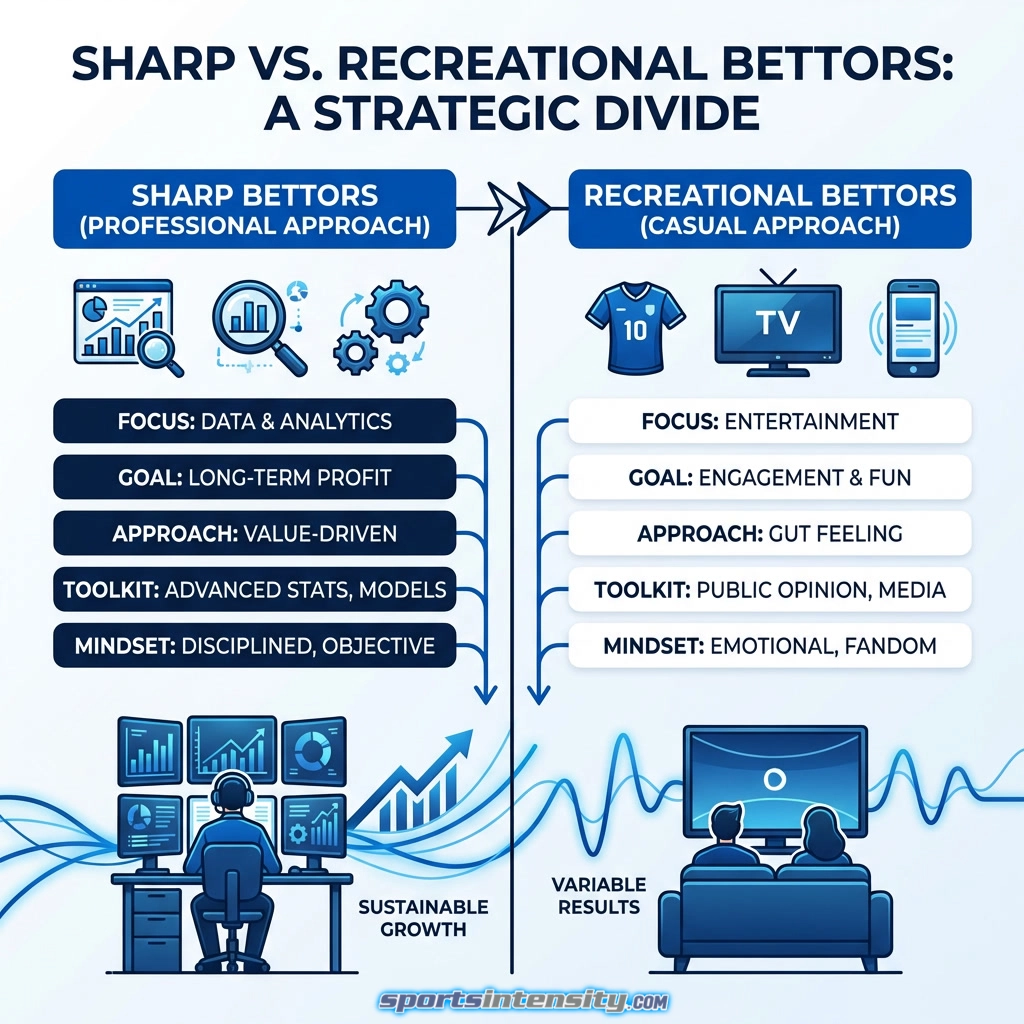
The difference between sharp, retail, and recreational sports bettors isn’t about intelligence, passion, or even how often someone bets. It’s about how they relate to the market. Both types of sports bettor may watch the same games, place wagers on the same teams, and even use the same sportsbooks, but they’re playing fundamentally different games. A recreational is participating for entertainment and emotional engagement; the other is navigating a pricing environment where every number matters.
Where the Terms Come From
The language of “sharp,” “retail,” and “recreational” didn’t originate in bettor culture; it began inside sportsbook trading rooms. These were operational categories used to manage risk, move lines, and control exposure. Bookmakers needed shorthand to describe different types of action hitting their board. Some bets carried informational weight. Others were simply volume. Some accounts consistently beat closing numbers. Others chased favorites and parlays. Over time, those internal classifications hardened into vocabulary.
To a sportsbook, a “sharp” bettor is not a personality type. It is a risk flag. Sharp accounts are monitored closely because their wagers may signal pricing inefficiencies. If a bettor repeatedly beats the closing line, that bettor’s action becomes predictive. Limits may change. Lines may move. Promotions may quietly disappear. “Retail” money, by contrast, refers to the broad mass of public action that generally does not contain price-sensitive information. It is expected, priced into models, and often welcomed. “Recreational” bettors are usually part of that retail flow, defined less by account size and more by behavioral tendencies — late bets, parlays, favorites, overs, boosts.
More Than Risk Labels
Although these terms were born inside sportsbooks, they migrated into bettor vocabulary because they describe something real about how markets behave. Betting markets, like financial markets, move in response to information and capital. If you don’t understand who is driving that movement, you are navigating blind.
When bettors talk about “sharp money” versus “public money,” they are trying to interpret line movement. Why did a spread move from -3 to -2.5 even though 70% of bets are on the favorite? That question only makes sense if you understand the distinction between bet count and respected money. The language gives bettors a way to think about information asymmetry — who might know something, who is reacting emotionally, and how prices adjust accordingly.
These categories also matter because sportsbooks treat them differently. Sharps may experience lower limits or tighter scrutiny. Retail accounts may receive larger promotional offers. A bettor who understands how they are likely to be categorized can make more informed decisions about line shopping, timing, and bonus usage.
Identity and Strategy
Beyond risk mechanics, the terms have become part of betting identity. Many bettors ask, implicitly or explicitly: “Am I sharp, or am I just recreational?” That question isn’t about ego as much as it is about process.
A recreational bettor may be perfectly knowledgeable about sports and still bet primarily for enjoyment. A retail bettor may track lines carefully but lack the volume or edge to influence pricing. A sharp bettor approaches the market differently: focusing on price, timing, and expected value rather than narrative or loyalty. These aren’t moral distinctions. They’re strategic ones.
The reason bettors care is simple: strategy depends on understanding your position. If you believe you’re betting into markets shaped by sharper participants, your timing decisions change. You may choose to bet early before the line moves. You may wait for public overreaction. You may prioritize beating the closing number over chasing big payouts.
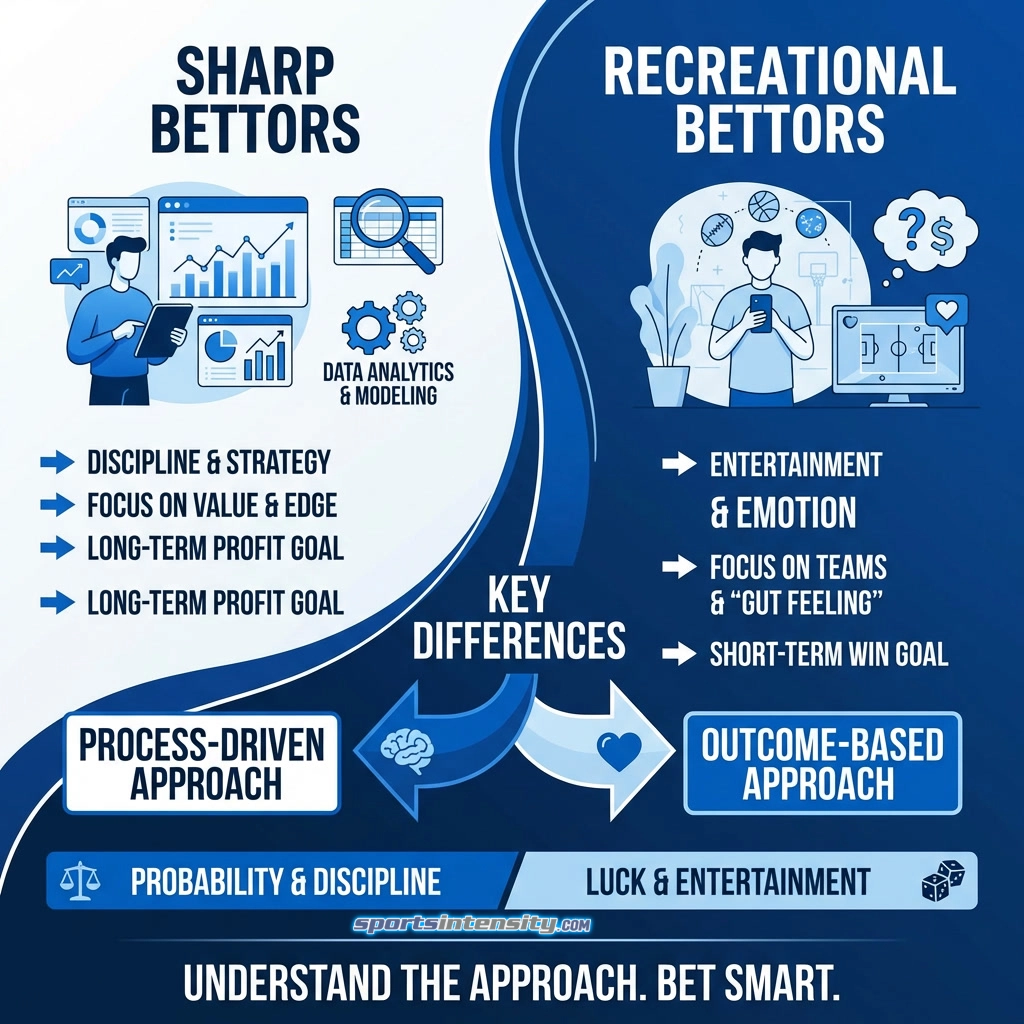
These aren’t abstract questions. They reflect practical concerns about limits, pricing, and market behavior. Bettors want to understand whether following steam is meaningful. They want to know why accounts get restricted. They want to know whether betting smaller amounts protects them from scrutiny. The terminology provides a framework for those discussions.
In other words, the words endure because they help explain observable market phenomena.
The Market Is Reality
Sportsbooks balance all three. That balancing act is why the terms persist. They describe how markets digest opinion, capital, and uncertainty. And while the labels may originate in bookmaker spreadsheets, they matter to anyone placing a bet in those markets. Because once you understand whether you are taking price or shaping it, you start seeing the board differently — not as a set of games, but as a live, moving marketplace where identity influences outcome long before the final whistle.
At the deepest level, these distinctions are about information flow. Markets function by incorporating information into prices. Sharps are assumed — rightly or wrongly — to contribute higher-quality information. Retail bettors contribute volume. Recreational bettors contribute liquidity and narrative-driven demand.
Sharp vs Retail FAQs
A sharp bettor is someone whose wagers are respected by sportsbooks because they consistently beat closing lines or identify pricing inefficiencies. Their action may trigger line movement, even at relatively modest stake sizes.
Because sportsbooks weigh the amount and credibility of money, not just the number of tickets. A smaller number of large, respected bets can outweigh many smaller retail wagers.
Sharp bettors lose bets like anyone else. The difference is that their long-term strategy aims to exploit price inefficiencies rather than predict every outcome correctly.
Sportsbooks use these categories to manage risk, adjust limits, move lines, and tailor promotions. Sharp bettors are monitored for informational value; retail bettors generate predictable volume.
Not exactly. Most recreational bettors are retail, but not all retail bettors are purely recreational. Retail describes market position; recreational describes mindset and behavior.
Understanding these distinctions helps bettors interpret line movement, anticipate limits, and develop better timing strategies. It also clarifies how markets absorb information.
In some cases, yes. If an account consistently beats the market, sportsbooks may reduce limits or restrict certain promotions to manage risk.