
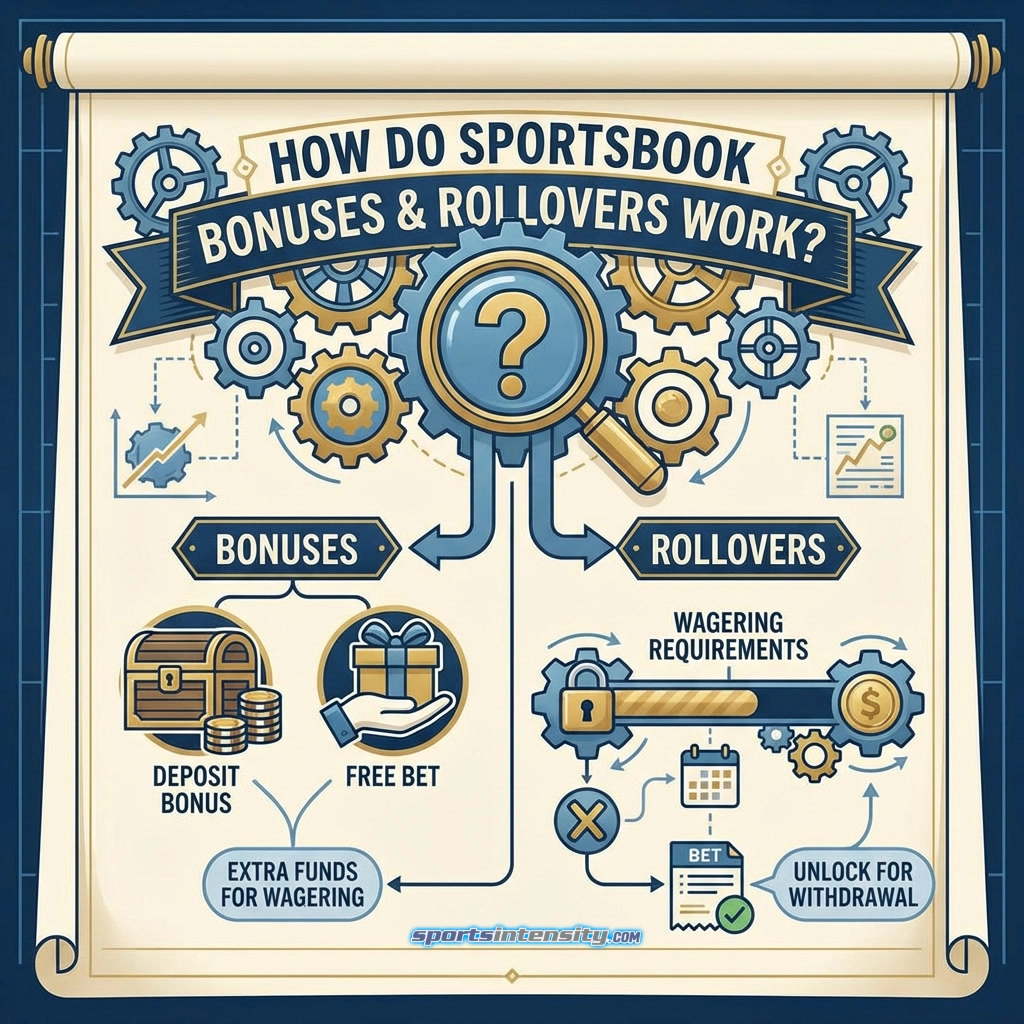
If you’ve ever wondered how sportsbook bonuses and rollovers work, this guide is for you. Below is a step-by-step guide, using a real sportsbook as an example, that walks you through the bonus rules and rollover requirements required to get a sportsbook bonus.
With offshore sportsbooks, bonuses are the free! money! incentives sportsbooks offer — generally as a percentage match of your deposit or simply an amount extra funds or plays to bet with. This free money is almost always tied to rollover requirements — a volume of betting you have to turn over before you can withdraw not only the bonus funds but often the original deposit tied to that bonus. The best offshore sportsbooks spell the mechanics of these rollover requirements out quite clearly across the different welcome and reload bonuses, and understanding them is essential to judging their real value rather than being lured by fat bonus numbers. We’ll use the bonuses and rollovers at Bookmaker eu, one of our six most trusted offshore sportsbooks, as an example to show how it works.
At the heart of any bonus is the rollover requirement, which is simply a multiplier applied to your deposit+bonus balance indicating how much betting action you must place before the funds are considered “cleared” for withdrawal. According to BookMaker’s rules, even a plain deposit carries a 1× rollover — that means you must place bets equal to your deposit amount before you can withdraw, even if you didn’t take a bonus. When you do claim a bonus, this multiplier increases significantly: a bonus with a 8× rollover means you must bet eight times your combined deposit and bonus before anything becomes eligible to be cashed out.
BookMaker offers a 25% bonus up to $500 on first deposits made with non-crypto methods, and a 20% bonus up to $500 on crypto deposits. Both of these carry a rollover requirement of 8× the combined amount before withdrawals can be made. Rollovers are applied inside the Cashier at deposit time, meaning you must opt into the promotion and accept it before making the qualifying deposit. To slow this all down, let’s walk through an example.
The Bonus
• You deposit $500 in crypto
• You receive Bookmaker’s 20% crypto bonus: 20% x $500 = $100 bonus
• Your $500 deposit + your $100 in bonus now = a $600 balance.
The Rollover:
The rollover requirement is 8×, that means you must wager $600 × 8 = $4,800. So you need to place $4,800 worth of qualifying bets before any portion of that $600 balance becomes eligible for withdrawal.
Here’s an Important detail: rollover is about bet volume, not losses. You don’t need to lose $4,800—you need to risk $4,800 in settled bets. Winning bets count toward rollover too, but sportsbooks usually apply a rule such as “the lesser of risk or win counts” on winning bets. For example, if you risk $110 to win $100 and win, typically only $100 counts toward rollover—not $210.
Once you complete the full $4,800 in qualifying wagers, the rollover requirement is cleared, and our remaining balance becomes withdrawable cash, subject to standard withdrawal rules. However, if you try to withdraw before clearing rollover, the sportsbook can void the bonus, or reduce your withdrawal to your deposit minus any losses, depending on the terms.
This is why rollover size matters more than the bonus percentage. A 20% bonus with an 8× rollover requires far more betting than a 50% bonus with a 5× rollover, even though the bonus is smaller.
The reason sportsbooks apply rollover is straightforward: it ensures that bettors use the funds in actual wagering rather than depositing solely to withdraw. From the operator’s perspective, a plain deposit (even without a bonus) with a 1× rollover protects them from immediate withdrawal before any bets are made, while higher rollovers on bonuses justify the promotional value being offered. For bettors, the lesson of how bonuses and rollovers work is that you should always calculate the effective amount of wagering required, rather than focus on the bonus percentage or the headline cap. — if you want to take maximum crypto bonus of $500, you need to deppsit $2500 and then wager the 8x rollver of the combined deposit + bonus amount of $3000, which means betting $24,000 before that bonus is eligible for withdrawal.
Finally, while rollover requirements are the core playthrough rule, they aren’t the only condition you’ll see in bonus terms. Minimum deposit thresholds, eligible payment methods (e.g., crypto versus credit/debit), geographic eligibility, and how and where the bonus must be claimed (often done via the Cashier during deposit) all shape the real value of the promotion.
Is It Better To Skip The Bonus?
For bettors that care about liquidity and bankroll survival it’s often better to decline a bonus altogether rather than accept one automatically. The reason is simple: bonuses almost always come with rollover requirements that lock up not just the bonus, but your deposit as well, until a specific wagering threshold is met. If you bet without claiming a bonus, most sportsbooks impose only a minimal requirement (often a 1× playthrough on the deposit or simply requiring that at least one wager be settled), which means you’re free to withdraw winnings whenever you choose.
By contrast, even a modest bonus can force you into thousands of dollars in required betting, potentially pushing you to place wagers you wouldn’t otherwise make just to clear the rollover. For bettors who value flexibility, shop lines aggressively, or plan to withdraw quickly after a winning run, skipping the bonus can be the more rational choice—trading headline “free” money for control over when and how their bankroll moves.