
Does an offshore gaming license matter to us sports bettors when we’ve been wronged, or is the license just a token comfort? The legitimacy a recognized gaming regulator’s license bestows on an offshore sportsbook is obvious: bettors are comforted by the thought that the offshore sportsbook will respect the rules of fair play because they’re subject to verifications and scrutiny. But for us sports bettors, when we have a complaint about a sportsbook, is that license anything more than a token comfort, or does it actually protect us?
For most U.S.-based sports bettors, the phrase “licensed and regulated” sits somewhere between comforting and meaningless. It appears at the bottom of the site of nearly every offshore sportsbook, stamped next to a crest from Curaçao, Malta, or some island you couldn’t find on a map without squinting. The question sophisticated bettors eventually ask is the only one that matters: do these licenses have any teeth, or are they just decorative seals meant to calm the nervous?
The honest answer is that an offshore gaming license does not protect players in the way state-regulated or U.K.-licensed books do. If a sportsbook licensed in New Jersey or Nevada refuses to pay you, you can escalate to a regulator who has the legal authority to compel action. That does not exist offshore. No U.S. bettor can sue a Curaçao or Mwali license holder in a domestic court and expect enforcement. In that sense, yes—offshore licenses are not “consumer protection” in the legal sense. But that doesn’t mean they’re meaningless. They serve a different function: they create business-level accountability in a market that otherwise would have none.
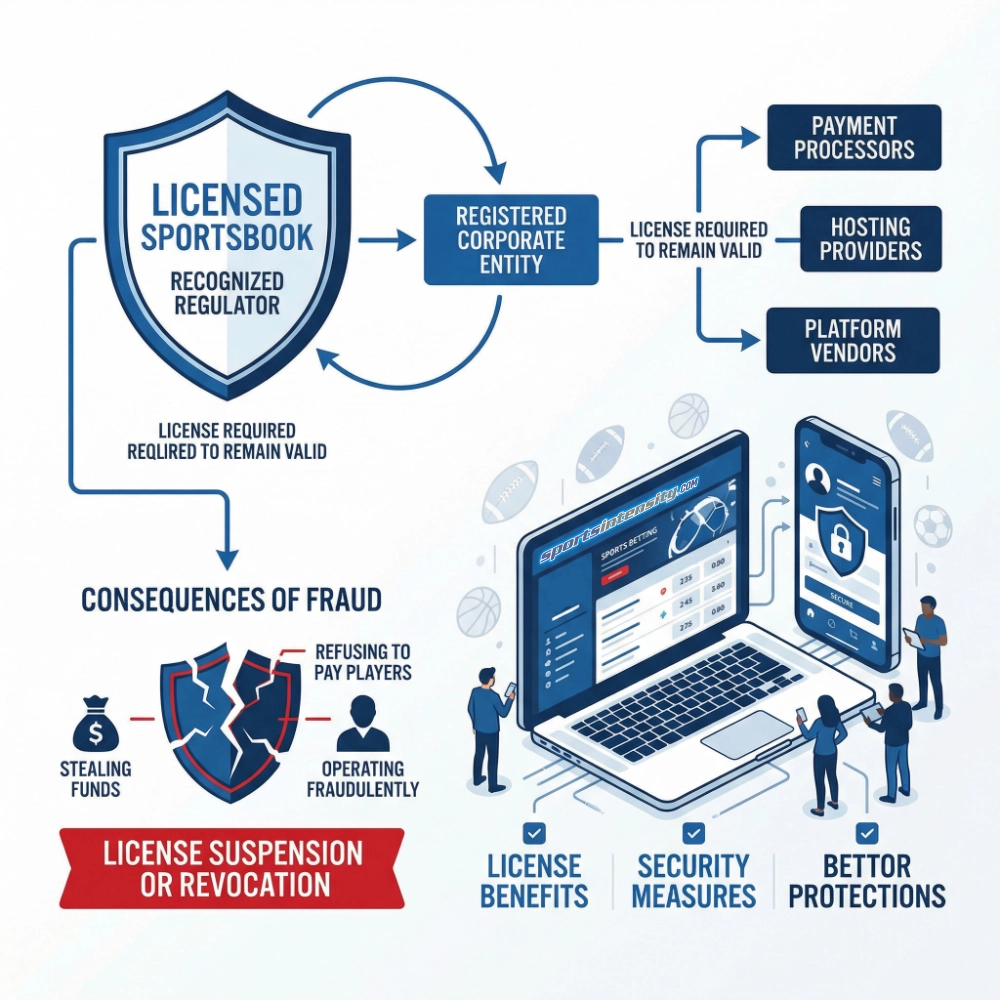
Think of an offshore gaming license less like a warranty and more like a collateral bond. A Curaçao-licensed sportsbook, for example, is anchored to a recognized regulator, a registered corporate entity, payment processors, hosting providers, and platform vendors that all require that license to remain valid. If that sportsbook is caught stealing funds, refusing to pay players, or operating fraudulently, the regulator can suspend or revoke its license. That might not help you recover last week’s parlay, but it destroys the sportsbook’s ability to process payments, host its platform, or even stay online. In the offshore world, that threat is what enforces behavior.
Offshore Gaming License Authorities
Curaçao remains the most meaningful of these offshore jurisdictions precisely because of this ecosystem. For decades it has been the default home of international sportsbooks. More recently, it has formalized its regulatory framework, requiring direct licenses, compliance documentation, and public license verification. A bettor can look up a Curaçao-licensed operator and confirm that it exists, who owns it, and whether its license is active. That doesn’t mean Curaçao will arbitrate your dispute, but it does mean the sportsbook is operating inside a system that other companies—banks, crypto exchanges, software providers—recognize and enforce. That is real leverage.
Costa Rica, by contrast, has long been the Wild West of offshore betting. It does not issue an offshore gaming license at all. Sportsbooks there operate under standard business registrations, not gambling regulation. That doesn’t automatically mean they’re scams—many of the best offshore sportsbooks are based there,—but it means there is no regulator for you to complain to, no license to lose, and no external oversight whatsoever. A Costa Rica-based sportsbook’s only restraint is its own reputation. For a bettor, that means you’re relying entirely on brand history and word-of-mouth, not on any regulatory backstop, and that’s often a stretch for newer bettors without a sense of which books to trust.
Mwali, in the Comoros Union, sits somewhere between these two worlds. It does issue gaming licenses, and it has been increasingly marketed to offshore operators over the past few years. But it is new, lightly documented, and not deeply embedded in the global payments and compliance ecosystem. In practical terms, a Mwali license is better than no license at all—it implies a registered company and some level of oversight—but it does not carry the same commercial weight as Curaçao. If a Mwali-licensed sportsbook misbehaves, there is far less assurance that processors, exchanges, or hosting providers will immediately step in to enforce discipline. The system simply isn’t as interconnected.
This is where experienced bettors separate legal theory from operational reality. You are not betting on whether a regulator will protect you. You are betting on whether the sportsbook has something to lose. Curaçao-licensed books have a lot to lose: their domain access, their payment rails, their software providers, their reputation in the professional betting ecosystem. Costa Rica books have almost nothing to lose except goodwill. Mwali books have something in between.
That’s why you’ll notice a pattern if you watch how sharp money behaves. Professional bettors may tolerate Costa Rica sportsbooks for opportunistic lines, or for a trusted offshore sportsbook they’ve grown to trust. Without that familiarity, they gravitate toward Curaçao-licensed operators, not because Curaçao will save them in a dispute, but because Curaçao makes cheating expensive. It ties the sportsbook into a web of commercial dependencies that punish bad behavior quickly and severely.
For a sophisticated U.S. bettor, that is the true value of offshore licensing. It is not about legal recourse. It is about risk containment. It is about choosing a sportsbook that is embedded in a system that punishes misconduct, rather than one that can vanish overnight. In a market where you can’t rely on courts, you rely on incentives. The stronger the license, the stronger the incentives to behave.